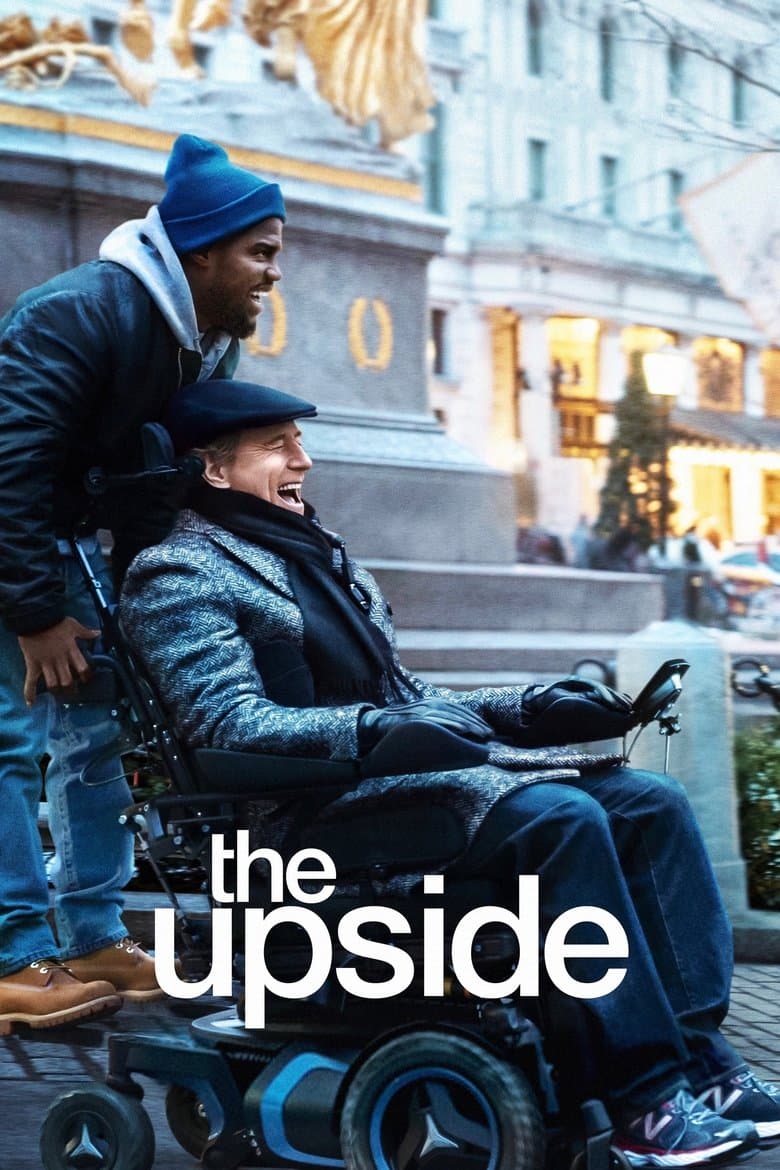
The Upside follows Dell Scott, a recently released prisoner who needs a job so he can stay out of trouble and see his young son. He takes a live-in care job with Phillip Lacasse, a rich New York writer who is paralyzed from the neck down and has lost hope after his wife's death. Dell knows little about care work, while Phillip lives in a quiet penthouse with helpers who protect him from risk. Their rough first days slowly turn into a funny and emotional friendship.
The film makes race, money, and disability the clear reasons these two men seem unable to understand each other. Dell brings Phillip back toward music, art, romance, and adventure, while Phillip pushes Dell to take fatherhood and work more seriously. The story presents personal kindness and honest friendship as the answer to these differences. It also uses a long catheter joke built around Dell's fear of touching another man's body, which gives the film a brief and dated gay-panic note.
Community feedback
Was our 25% Woke rating accurate?
Breakdown
These are the editorial factors and ratings behind our score for The Upside.
Woke representation / casting
The film places a black ex-con, Dell, beside a wealthy white wheelchair user, Phillip, as its two main leads. The story makes their race, class, and disability differences part of the friendship setup. The pairing follows the French source and fits a modern New York story, so it does not look like a quota-style group. The publicity calls the pair a bridge between white and Black worlds, which gives the casting a small representation signal.
18%
Woke political dialogue
Dell and Phillip talk about their different races, money, and life chances. Dell calls out Phillip's privilege during a fight about Dell's struggle to see his son. The film also uses jokes about rich people, white habits, and social class. These lines stay tied to the men's personal fight and do not become activist speeches.
14%
Identity-driven story themes
The story makes race, class, and disability differences the main reason the two leads seem far apart. Dell is a black parolee from a struggling family, while Phillip is a wealthy white man who uses a wheelchair. Their bond is meant to show that people from very different groups can find common ground. A brief catheter joke uses Dell's fear of touching another man's body as humor about seeming gay, but the film does not build a queer storyline.
28%
Western institutional / cultural critique
Not present. No activist-style attacks on capitalism, patriarchy, family norms, or Western institutions. The wealthy character is portrayed positively, and struggles stay personal.
0%
Woke character or canon changes
Not relevant. The American version keeps the original French story’s interracial caregiver setup without ideological race swaps, gender changes, or added activist elements.
0%
Anti-woke backlash and complaints
Not present in this title.
0%
Creator track record context
Neil Burger said the story spoke to a growing divide between people and to finding common ground. The available record for Burger, Toledano, and Nakache is mostly mainstream and low on activist work. Jon Hartmere has earlier work about gay teenagers and has worked on stories about women's self-discovery. Steve Tisch has mild Democratic ties, while the other listed producers and crew show little political activity.
22%
Production

Movie · 2022
The remarkable true story of how retiree Jerry Selbee discovers a mathematical loophole in the Massachusetts lottery and, with the help of his wife, Marge, wins $27 million…
Movie · 2019
Ten fishermen from Cornwall are signed by Universal Records and achieve a top ten hit with their debut album of Sea Shanties.
Movie · 2022
Maurice Flitcroft, a dreamer and unrelenting optimist, managed to gain entry to The British Open Golf Championship qualifying in 1976 and subsequently shot the worst round in Open…

Movie · 2020
Four stagnant high school teachers decide to test out a theory that maintaining a constant level of intoxication will improve their overall lives.
Movie · 2023
The true story of how Dave Fishwick, a working class man and self-made millionaire, fought to set up a community bank so that he could help the local businesses of Burnley not…

Movie · 2018
An American hypochondriac who is working as a baggage handler is forced to confront his fears when a British teenager with a terminal illness enlists him to help her carry out her…
Movie · 2017
Brigsby Bear Adventures is a children's TV show produced for an audience of one: James. When the show abruptly ends, James's life changes forever, and he sets out to finish the…
Movie · 2017
When dictator Joseph Stalin dies, his parasitic cronies square off in a frantic power struggle to become the next Soviet leader.
