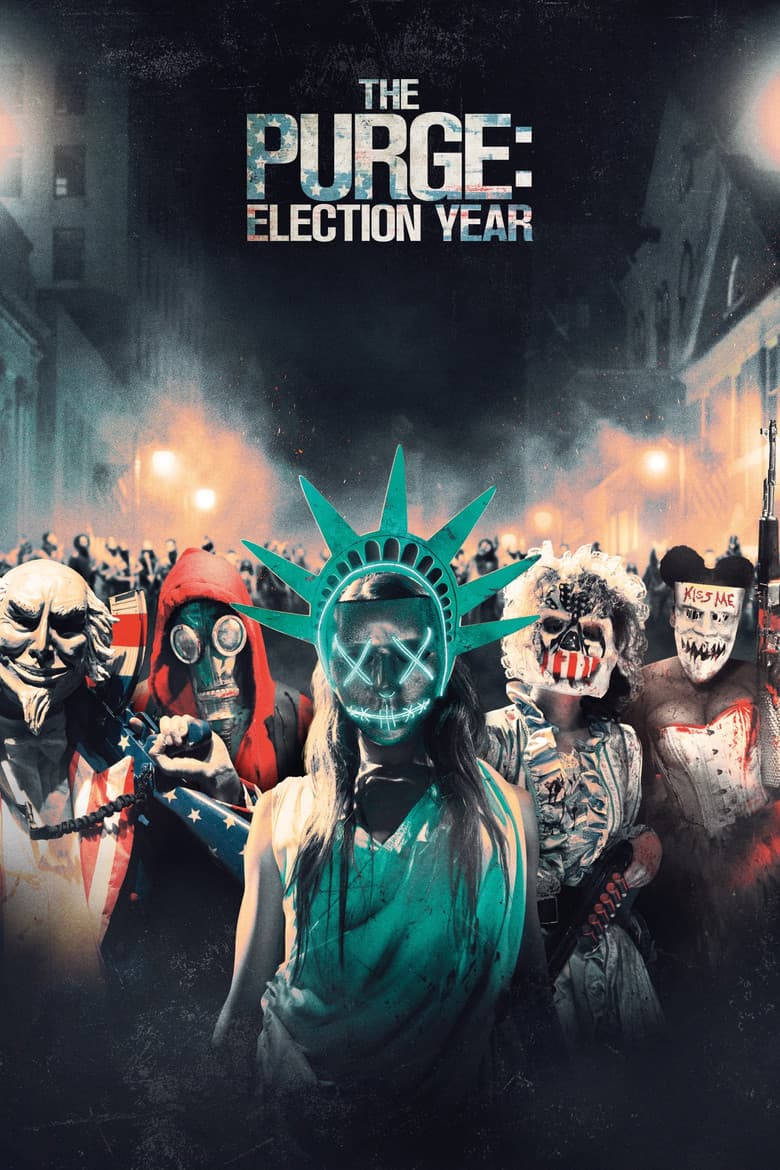
The Purge: Election Year follows Senator Charlene Roan campaigning to abolish the annual Purge while surviving a government-backed assassination attempt on that night, protected by her security chief and aided by working-class allies in Washington, D.C. The story centers on political survival, election optics, and resistance to the NFFA regime that weaponizes the Purge for control. Explicit ideological dialogue repeatedly frames the Purge as a capitalist mechanism that benefits the rich by eliminating the poor, with debates and rants targeting conservative extremism, insurance profiteering, and religious influence in politics. Recurring class and racial undertones appear through minority characters supporting the white female senator's moral cause against elite villains depicted with neo-Nazi imagery.
Community feedback
Was our 81% Woke rating accurate?
Breakdown
These are the editorial factors and ratings behind our score for The Purge: Election Year.
Woke representation / casting
Casting fits the near-future urban D.C. and working-class setting without audience-visible forced diversity, identity signaling, or mismatches; roles align logically with demographics and premise.
15%
Woke political dialogue
Strong recurring explicit dialogue and debate scenes advance left-wing framing of the Purge as elite exploitation of the poor, with direct attacks on insurance companies and conservative/religious candidates portrayed as villains.
76%
Identity-driven story themes
Recurring class and racial undertones position poor and minority characters as moral heroes aiding a white female politician against oppressive elites, including noted white-savior dynamics in critical analysis.
37%
Western institutional / cultural critique
Central portrayal of NFFA as far-right authoritarian regime tied to evangelical Christianity, neo-Nazis, and capitalist exploitation frames conservative institutions and values as systemic enablers of violence and inequality.
71%
Woke character or canon changes
Not present in this title.
0%
Anti-woke backlash and complaints
Conservative reviews explicitly called out liberal propaganda, anti-conservative rants, and Christian-slam elements; partisan discussion occurred but remained review-based without large-scale identity-focused anti-woke outrage.
40%
Creator track record context
DeMonaco’s Purge franchise shows consistent left-leaning political satire targeting right-wing extremism and capitalism, reinforced by his interviews framing the NFFA as far-right.
53%
Production
Movie · 2020
Rachel is a divorced single mother whose bad day gets even worse. She's running late to drop her son off at school when she honks her horn impatiently at a fellow driver during…
Movie · 2019
After barely surviving a furious shootout with the police, Baby Firefly, Otis Driftwood and Captain Spaulding are behind bars. But pure evil cannot be contained.

Movie · 2019
A man steps out of a park fountain in Ho Chi Minh City with no recollection of who he is or where he came from.
Movie · 2020
A family vacation takes a terrifying turn when parents Paul and Wendy discover their young daughter has vanished without a trace.

Movie · 2018
After an unprecedented global pandemic has turned the majority of humankind into violent infected beings, Morgan, a man gifted with the ability to speak the infected's new…

Movie · 2024
In a world where no one speaks, a devout female hunts down a young woman who has escaped her imprisonment. Recaptured by its ruthless leaders, Azrael is due to be sacrificed to…
Movie · 2024
Characters from different backgrounds are thrown together when the plane they're travelling on crashes into the Pacific Ocean.
Movie · 2019
A typical night for veterans at a VFW turns into an all-out battle for survival when a desperate teen runs into the bar with a bag of stolen drugs.
