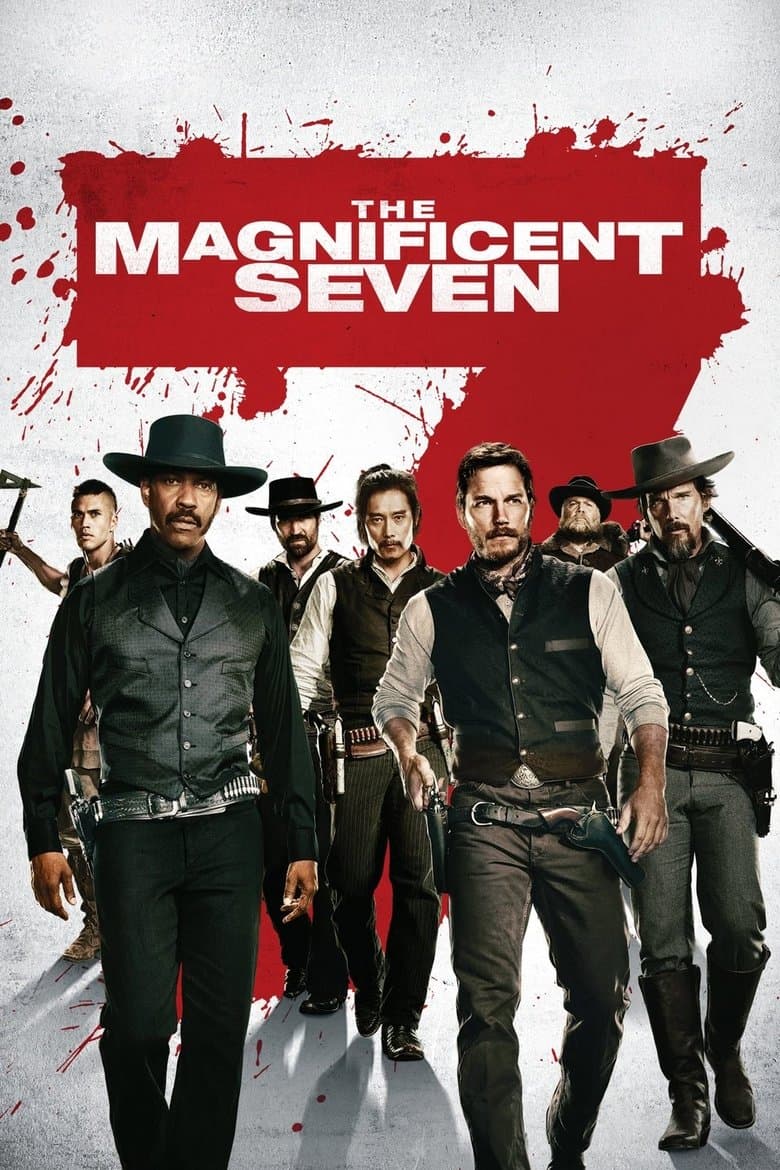
The Magnificent Seven is a 2016 Western action movie about seven gunmen who defend a small town from a greedy mining boss. The movie updates the classic 1960 story by casting a highly diverse group of heroes of different races, led by a black bounty hunter. A prominent female character hires the men, trains with weapons, and personally kills the main villain in the final battle. Additionally, the villain gives a speech that critiques capitalism.
Community feedback
Was our 39% Woke rating accurate?
Breakdown
These are the editorial factors and ratings behind our score for The Magnificent Seven.
Woke representation / casting
The movie replaces the original's mostly white cast with a highly diverse, modern-looking group of heroes. This team is led by a black bounty hunter and includes East Asian, Mexican, and native American gunslingers. The film also features a strong female lead who trains with guns and actively fights alongside the men. These choices clearly prioritize visible diversity and representation over strict historical accuracy or faithfulness to the original source material.
35%
Woke political dialogue
The characters do not deliver modern progressive speeches or use contemporary social justice jargon. However, the film includes a highly political, anti-capitalist sermon by the villain, Bartholomew Bogue, who equates capitalism with his own greed and predation. Aside from this anti-market rant, the dialogue stays within standard Western action conventions.
15%
Identity-driven story themes
The movie mostly avoids discussing the racial identities of its diverse heroes, treating the Old West as a post-racial space. However, it heavily emphasizes themes of female empowerment and self-determination through the character of Emma Cullen. Her arc of taking matters into her own hands and refusing to be a damsel in distress adds a clear modern gender-empowerment theme to the story.
15%
Western institutional / cultural critique
The film features a clear systemic critique of capitalism through the main villain, who uses Gilded Age corporate industrialism as a tool of terror. He directly links his violent greed to the market economy. However, the film does not critique other traditional Western institutions, such as the family, nor does it push activist themes like patriarchy or whiteness.
20%
Woke character or canon changes
The remake makes major changes to the classic 1960 source material to fit modern representation goals. It replaces the passive Mexican villagers of the original film with a multi-racial crew protecting a white town. It also replaces the passive male recruiters with Emma Cullen, a capable woman who drives the plot and ultimately takes the final kill shot on the villain.
30%
Anti-woke backlash and complaints
Some conservative viewers and commentators complained about the "politically correct" and historically inaccurate casting of the main team. Others criticized the film's anti-capitalist themes and the decision to have a female character kill the main villain. However, this backlash was relatively quiet compared to other major reboots of the time.
25%
Creator track record context
The primary creative team has a very low history of social justice activism. Director Antoine Fuqua and writers Nic Pizzolatto and Richard Wenk are known for standard, grit-and-action commercial thrillers. While casting director Mary Vernieu has supported representation and script supervisor Dawn Gilliam has worked on DEI committees, the core filmmakers have a strong non-activist history.
11%
Production
Movie · 2018
When an IMF mission ends badly, the world is faced with dire consequences. As Ethan Hunt takes it upon himself to fulfill his original briefing, the CIA begin to question his…
Movie · 2016
A thousand years ago, one boy with a dream of becoming a great warrior is abducted with his sister and taken to a land far away from home.
Movie · 2019
When Alita awakens with no memory of who she is in a future world she does not recognize, she is taken in by Ido, a compassionate doctor who realizes that somewhere in this…
Movie · 2018
Framed and on the run, a former FBI agent must save his family from a blazing fire in the world's tallest building.
Movie · 2024
Following their explosive showdown, Godzilla and Kong must reunite against a colossal undiscovered threat hidden within our world, challenging their very existence – and our own.
Movie · 2025
After a family tragedy, kung fu prodigy Li Fong is uprooted from his home in Beijing and forced to move to New York City with his mother.
Movie · 2017
The Guardians must fight to keep their newfound family together as they unravel the mysteries of Peter Quill's true parentage.
Movie · 2018
As the Avengers and their allies have continued to protect the world from threats too large for any one hero to handle, a new danger has emerged from the cosmic shadows: Thanos.
