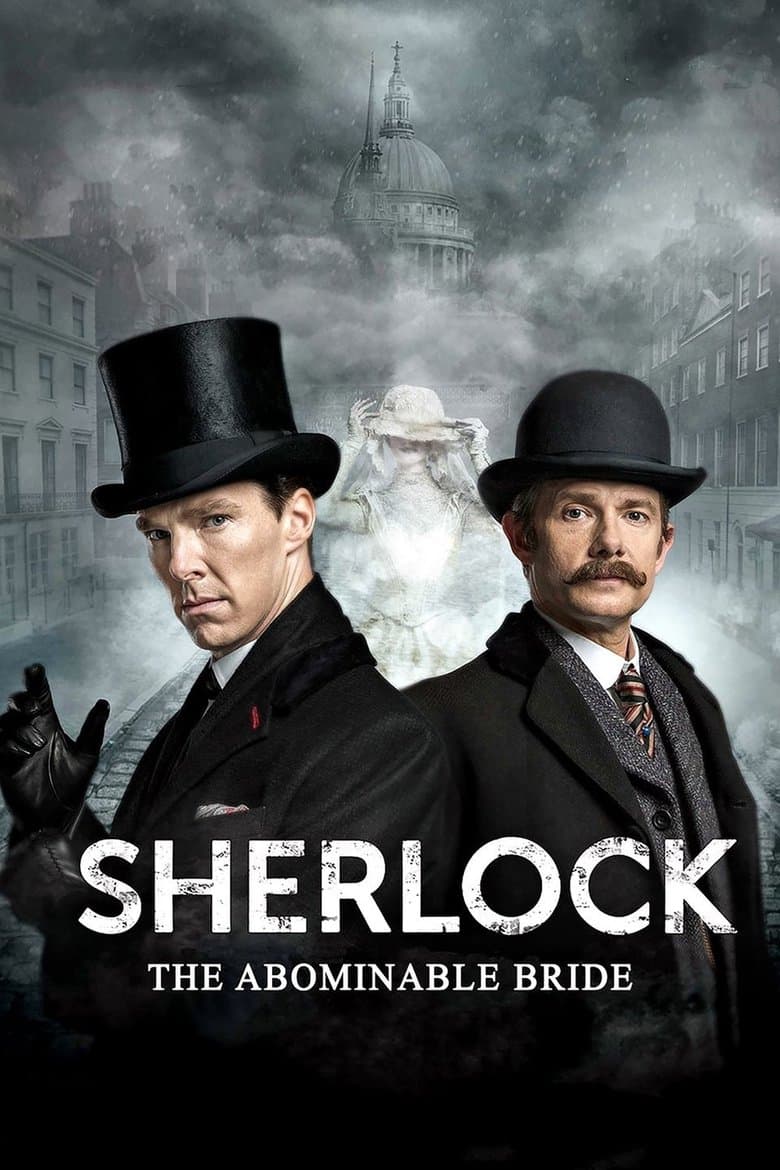
Movie review
January 1, 2016 · 90 min · PG-13 · Crime · Mystery · Thriller · Drama
Modern Sherlock uses a drug-fueled mind palace to restage an unsolved Victorian case. A ghostly bride seems to kill men after her own suicide. In 1890s London, Holmes and Watson learn that a secret women's-rights network used Emelia Ricoletti as a martyr to murder abusive husbands. The puzzle is meant to help Sherlock understand Moriarty's return. The special ends with a Reichenbach mindscape clash and a hint that the modern series might be Victorian Holmes's dream.
The special is mainly a gothic period puzzle, yet its central mystery is about gender power. Emelia's ghost is really a hooded women's-rights society that faked her death, killed her husband, and keeps murdering men who wronged them. Mary campaigns for votes for women, and Molly works as a pathologist only by dressing as a man. Mycroft says the invisible army of women is a battle men must lose because they are right and men are wrong. Sherlock frames it as a war of one half of the human race against the other and says that once the idea exists, it cannot be killed.
Community feedback
Was our 77% Woke rating accurate?
Breakdown
These are the editorial factors and ratings behind our score for Sherlock: The Abominable Bride.
Woke representation / casting
The leads fit Victorian London and stay white British. The noticeable choices are Molly dressing as a man to work as a pathologist and a secret network of women as the hidden power. Series-regular Janine appears, and the show keeps joking that Holmes and Watson act like a couple.
24%
Woke political dialogue
The show has clear equality lines such as "votes for women." Mycroft says women are right and men are wrong. Sherlock gives a speech about half the human race in a war and says the idea cannot be killed. Period sexist banter sets those lines up.
64%
Identity-driven story themes
The whole case solution is a women's-rights revenge cult and gender-war story. Emelia is a martyr for equality, Mary is a suffragette, and male power is framed as something men should lose. A brief queer-bait line from Moriarty sits on top of that.
70%
Western institutional / cultural critique
The story strongly critiques Victorian male entitlement, abusive marriage, and sidelined wives and landladies. Men's way of life is called wrong. It is not a broad attack on Christianity, capitalism, or whiteness.
50%
Woke character or canon changes
Doyle's throwaway abominable wife becomes an original feminist murder society. Five Orange Pips Klan terror is reworked as purple-hooded women's-rights killers. Holmes and Watson themselves are not race-swapped or gender-swapped.
44%
Anti-woke backlash and complaints
There was almost no organized anti-woke campaign. Debate was dominated by left and feminist claims of mansplaining, failed feminism, and bad Klan imagery. Only thin scattered gripes appeared about a man-hating or heavy-handed feminist slant.
6%
Creator track record context
Moffat has the strongest feminist-leaning writing reputation in the cached scores. Gatiss, Mackinnon, Doyle, and lower-scoring producers pull the overall creative record only into the mild-moderate range. The combined track record is not extreme.
28%
Production
Movie · 2017
Cairo, 2011. A police officer investigates the murder of a woman in a luxurious hotel in the days leading up to the Egyptian revolution.
Movie · 2016
A naval officer is devastated to learn about his wife's extramarital affair with a rich businessman while he was away.
Movie · 2023
Based on a true story. 15-year-old Kara Robinson was kidnapped, assaulted and held captive for 18 hours. With her survival instincts kicking in, she plots a daring escape from the…
Movie · 2019
A charismatic New York City jeweler always on the lookout for the next big score makes a series of high-stakes bets that could lead to the windfall of a lifetime.
Movie · 2018
After David Kim's 16-year-old daughter goes missing, a local investigation is opened and a detective is assigned to the case.
Movie · 2021
A cold and mysterious new security guard for a Los Angeles cash truck company surprises his co-workers when he unleashes precision skills during a heist.
Movie · 2019
During the 1980s, a failed stand-up comedian is driven insane and turns to a life of crime and chaos in Gotham City while becoming an infamous psychopathic crime figure.

Movie · 2017
A newly-released prison gangster is forced by the leaders of his gang to orchestrate a major crime with a brutal rival gang on the streets of Southern California.
