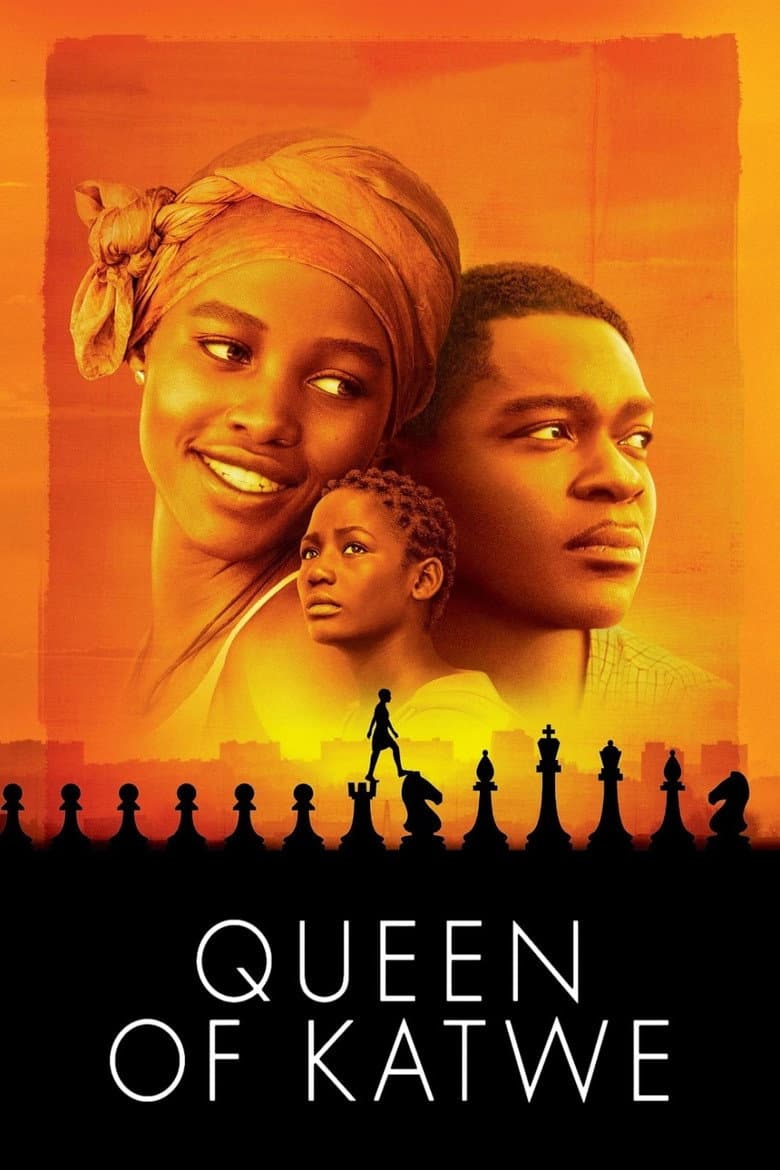
Queen of Katwe follows Phiona Mutesi, a girl from the slums of Uganda who rises to become a skilled chess player. She joins a chess club run by a missionary coach and faces poverty, family strain, and class friction with elite schools. Her older sister is pulled into sexual exploitation while Phiona climbs the competitive ranks. The film is a true story told as an underdog sports and family drama. It does not center a Western hero who saves the day.
The cast is largely African and matches the Kampala setting and the real lives behind the story. Secondary notes include a girl rising in a male heavy sport, a strong widowed mother, and pride in African self representation over tired suffering clichés. Dialogue focuses on poverty, grit, and class snobbery when slum players enter private school tournaments. On screen conflict stays with Ugandan class hierarchy rather than attacks on Western institutions, and the missionary coach is a positive figure. The film does not push modern activist identity lectures, queer themes, or heavy identity politics as its main thesis.
Community feedback
Was our 31% Woke rating accurate?
Breakdown
These are the editorial factors and ratings behind our score for Queen of Katwe.
Woke representation / casting
The Uganda setting uses African leads and largely local casting that match the place and the real people in the story. The score reflects how marketing and cast and crew talk sold the film as a Disney diversity milestone and an all black African inclusion win. It is not about wrong ethnicity casting in Kampala. The story world fits the source lives more than a forced diversity swap.
22%
Woke political dialogue
The talk on screen is mostly about poverty, hard work, and class snobbery when slum players enter private school events. There is little modern activist identity language. Class put downs and underdog replies stay light and tied to the plot. The film does not lecture in the style of current political slogans.
12%
Identity-driven story themes
The main arc is a classic rags to chess underdog story about family survival. You also see a girl rising in a male heavy sport, a strong widowed mother, and a push to tell African stories without tired suffering clichés. Those notes are real but secondary to the sports climb. Press talk about empowerment and diversity is stronger than any single DEI thesis inside the plot.
32%
Western institutional / cultural critique
The main fights on screen are Ugandan class ranks and poverty. The film does not mount a long attack on Western institutions, Christianity, or traditional family. The missionary coach is shown as a good figure. Talk about avoiding white savior tropes is mostly outside the story, not anti Western activism in the plot.
8%
Woke character or canon changes
Not relevant. This is a biographical adaptation of a living person and documented events.
0%
Anti-woke backlash and complaints
There was no lasting campaign that called the film too woke or a DEI agenda piece at release. A few fringe voices used propaganda language. Later chatter loosely linked music supervisor and AD Zohran Mamdani to Woke Disney flop talk. None of that defined the title for most viewers.
3%
Creator track record context
Director Mira Nair often works with diaspora life, marginal communities, and cultural identity. Editor Barry Alexander Brown has long ties to Spike Lee’s social films. Zohran Mamdani had minor assistant director and music supervisor credits. The writer and most other ADs and producers pull the score down, so the overall lift is moderate through Nair as the visible author.
34%
Production
Movie · 2024
Inspired by the incredible true story of a hairdresser who single-handedly rallies an entire community to help a widowed father save the life of his critically ill young daughter.
Movie · 2023
Hirayama is content with his life as a toilet cleaner in Tokyo. Outside of his structured routine, he cherishes music on cassette tapes, books, and taking photos of trees.
Movie · 2023
British stockbroker Nicholas Winton visits Czechoslovakia in the 1930s and forms plans to assist in the rescue of Jewish children before the onset of World War II, in an operation…

Movie · 2018
A father and daughter live a perfect but mysterious existence in Forest Park, a beautiful nature reserve near Portland, Oregon, rarely making contact with the world.
Movie · 2021
The enthralling, against-all-odds story that transfixed the world in 2018: the daring rescue of twelve boys and their coach from deep inside a flooded cave in Northern Thailand.
Movie · 2016
Based on the life story of Mahendra Singh Dhoni, and his journey to being the world cup winning captain of the Indian cricket team.

Movie · 2019
A look at the Apollo 11 mission to land on the moon led by commander Neil Armstrong and pilot Buzz Aldrin.
Movie · 2018
Dan, a 21-year-old carefree boy is always surrounded by a bunch of friends and fellow hotel interns who feed off each other's everyday moments, their ups and downs.
