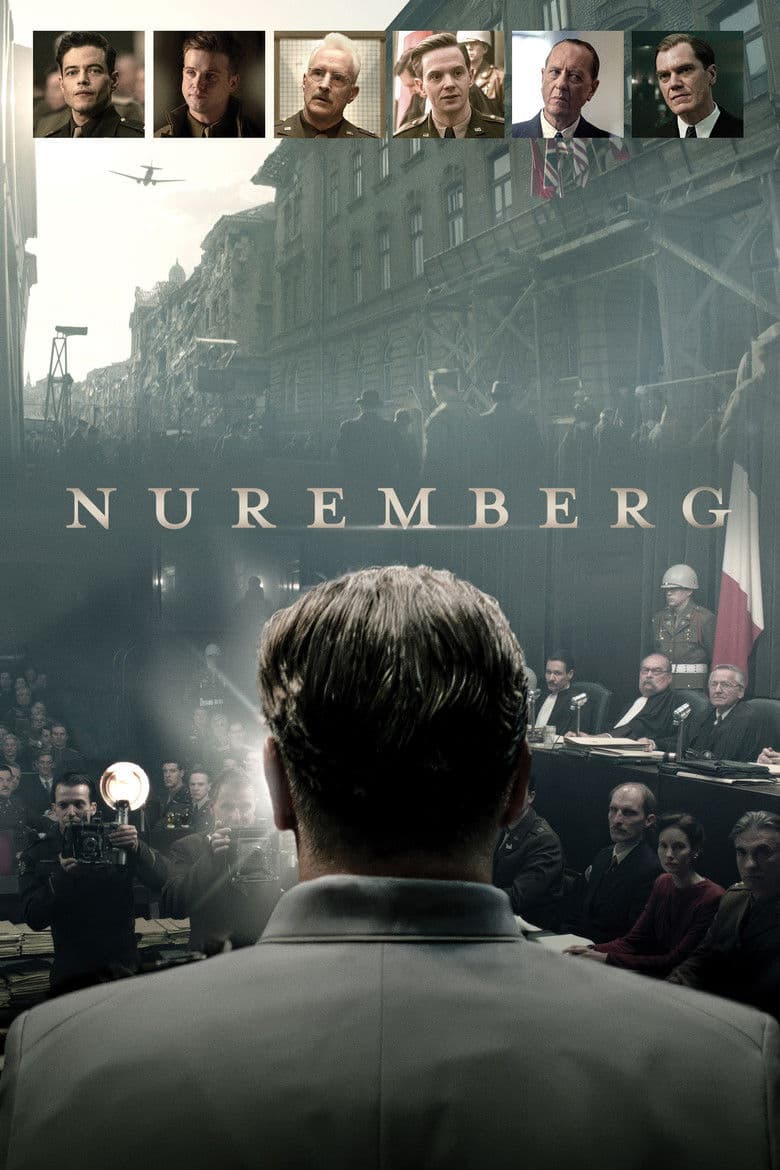
Nuremberg follows Douglas Kelley, a U.S. Army psychiatrist sent to postwar Germany in 1945. He must test Nazi prisoners and keep them alive and fit for trial. Kelley becomes locked in a battle of minds with Hermann Göring, Hitler’s former second in command, while Robert Jackson and Allied lawyers build the case against the Nazi leaders. The film moves between prison interviews, ruined German streets, legal meetings, and the courtroom, with a serious tone that sometimes uses sharp jokes and showy drama.
The film gives a clear warning that evil can wear a friendly face and can grow inside ordinary societies. In a late radio scene, Kelley says that people like the Nazis can exist in America and can gain power by turning citizens against one another. Göring’s line that Hitler made Germans feel proud again can sound like a modern political slogan. Rami Malek’s casting as the real-life white psychiatrist is a small visible mismatch, but the movie does not build its story around race, gender, sexuality, or diversity.
Community feedback
Was our 35% Woke rating accurate?
Breakdown
These are the editorial factors and ratings behind our score for Nuremberg.
Woke representation / casting
Rami Malek, an Egyptian-American actor, plays Douglas Kelley, a real white U.S. Army psychiatrist. The film does not present this choice as a diversity statement or use identity language to sell it. Most major roles match the real people and the 1940s setting. Howie Triest’s Jewish background has a direct plot reason. The result is a small audience-visible casting mismatch, not a broad representation pattern.
15%
Woke political dialogue
Douglas Kelley says in a late radio scene that Nazi-like people can exist in America and may gain power by turning half the public against the other half. Kelley warns that such people may not wear scary uniforms. Hermann Göring also says that Hitler made Germans feel German again, a line that echoes a modern political slogan. Most of the movie stays with wartime history, psychology, law, and personal guilt. The modern political warning is strong but largely confined to the closing section.
35%
Identity-driven story themes
Not present. The movie focuses on Nazi crimes, personal guilt, the psychology of evil, and legal accountability. Race, gender, sexuality, and modern identity politics do not drive the characters or story.
0%
Western institutional / cultural critique
The late radio scene says that the United States can also produce people who seek power by stoking hatred. This gives the film a brief modern critique of American political culture and national self-confidence. The movie still treats the Allied court and the rule of law as a needed answer to tyranny. It does not repeatedly attack Western culture, family life, religion, or ordinary social norms.
25%
Woke character or canon changes
Not relevant. The film changes timing and combines events for drama, but it does not use an identity or DEI message to rewrite a known person or event.
0%
Anti-woke backlash and complaints
Some right-leaning X users called the film anti-Trump propaganda and said Göring was written as a stand-in for Trump or MAGA. Other posts called it left-wing propaganda or a political “psyop.” The reaction had some real reach but stayed scattered, with no large boycott, review-bomb campaign, or organized action. Some right-leaning viewers instead praised the film as serious history. The backlash was notable but fringe and mixed.
35%
Creator track record context
James Vanderbilt mainly makes historical and true-event films about journalism, justice, and power. His known work shows no clear pattern of identity politics or representation advocacy. The listed producers have commercial film backgrounds and no documented activist or DEI record. This gives the title only a weak creator track record context.
10%
Production
Movie · 2026
While people across 1990s Iraq struggle to survive the war and food shortages, Saddam Hussein requires each school in the country to prepare a cake to celebrate his birthday.
Movie · 2020
A man refuses all assistance from his daughter as he ages and, as he tries to make sense of his changing circumstances, he begins to doubt his loved ones, his own mind and even…
Movie · 2016
In a desolate war zone where screams of the innocent echo, on the very line between disaster and valor, 7 Maroon Berets will dance with death.
Movie · 2025
Diagnosed with Tourette Syndrome at 15, John Davidson navigates his way against the odds through troubled teenage years and into adulthood, finding inspiration in the kindness of…
Movie · 2023
The story of J. Robert Oppenheimer's role in the development of the atomic bomb during World War II.
Movie · 2016
On 15 January 2009, the world witnessed the 'Miracle on the Hudson' when Captain 'Sully' Sullenberger glided his disabled plane onto the Hudson River, saving the lives of all 155…
Movie · 2016
WWII American Army Medic Desmond T. Doss, who served during the Battle of Okinawa, refuses to kill people and becomes the first Conscientious Objector in American history to…

Movie · 2022
A quiet, neglected girl is sent away from her dysfunctional family to live with relatives for the summer. She blossoms in their care, but in this house where there are meant to be…
