Movie review
November 3, 2017 · 114 min · PG-13 · Crime · Mystery · Drama
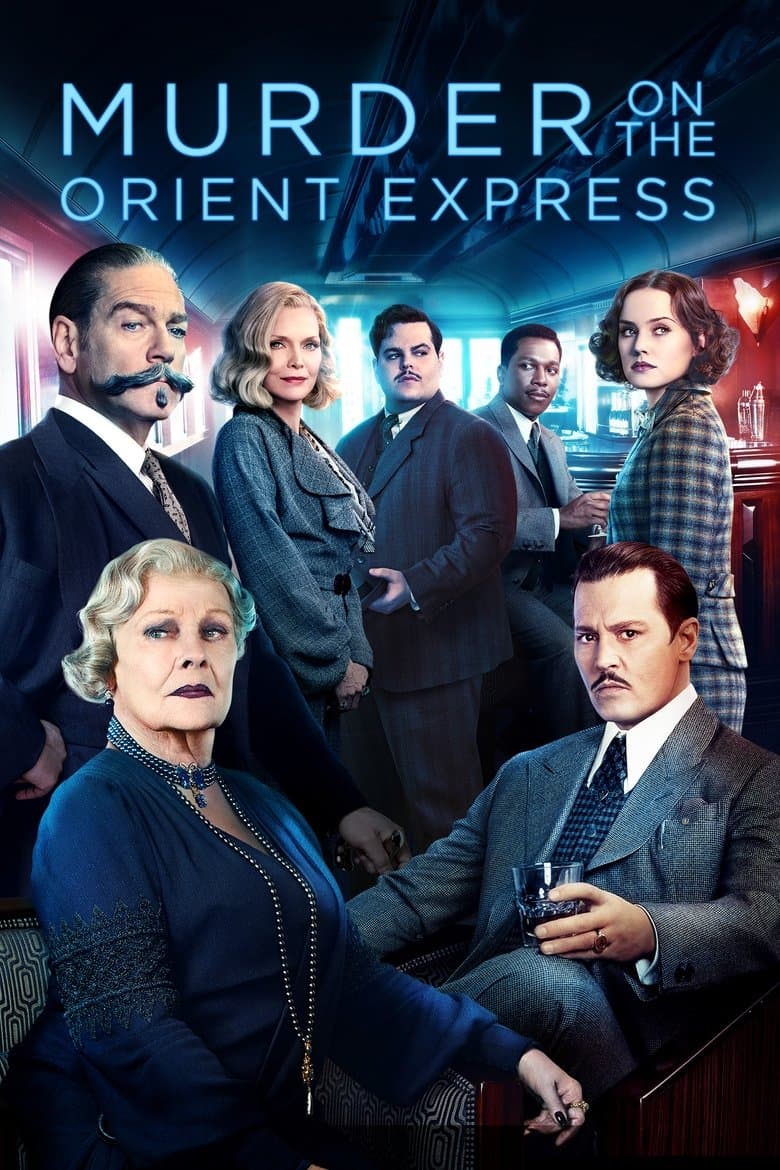
2017 adaptation of Agatha Christie's 1934 novel directed by and starring Kenneth Branagh as Hercule Poirot, who investigates a murder on the snow-stranded Orient Express and uncovers that the passengers are vigilantes delivering justice for the kidnapping and killing of a child. The core story examines law versus personal morality in a classic ensemble whodunit. This version inserts visible racial diversity through reimagined and new non-white characters plus recurring dialogues and subtext that explicitly call out 1930s racism, xenophobia, and far-right attitudes.
Community feedback
Was our 53% Woke rating accurate?
Breakdown
These are the editorial factors and ratings behind our score for Murder on the Orient Express.
Woke representation / casting
Prominent non-white casting additions and background swaps (black actor as key doctor facing explicit racism in interracial relationship; Latino actor as Cuban-American salesman) create clear audience-visible diversity emphasis and partial mismatch with the original novel's homogeneous European/American cast, even in an international train setting.
45%
Woke political dialogue
Characters voice period-specific racist slurs, xenophobic distrust ("not racist but" comments on Cubans), and far-right bigotry, met with direct acknowledgments of prejudice and mixed-race challenges; historical framing only with no modern activist language or lectures.
25%
Identity-driven story themes
Recurring subtext and interactions around racial suspicion, far-right attitudes, and societal barriers to non-white or mixed characters add a noticeable identity layer to the passenger dynamics and mystery, serving as a modern overlay without driving the central vigilante-justice plot.
35%
Western institutional / cultural critique
Limited historical nods to 1930s xenophobia, far-right ideology, and personal impacts of prejudice (including brief colonialism references); presented as era flaws without broader modern systemic attacks on Western institutions, patriarchy, capitalism, or traditional norms.
20%
Woke character or canon changes
Race and nationality reinterpretations plus amalgamations of original characters (English colonel/Greek doctor merged into black American; Italian salesman changed to Cuban-American) plus new diverse roles inserted specifically to enable racism themes—changes from Christie's 1934 text explicitly discussed as intentional modernization.
40%
Anti-woke backlash and complaints
Scattered reviewer notes that racial elements feel forced or hollow additions absent from the source; complete absence of significant social media firestorms, news headlines, or public debate accusing activist or left-wing messaging. Complaints remain weak and non-widespread.
10%
Creator track record context
Branagh and Green made deliberate, documented choices to diversify the cast and weave explicit racism/xenophobia commentary for added resonance, with Green tying diversity directly to better storytelling and Branagh repeating the approach in sequels; reflects a clear pattern of identity-conscious updating.
30%
Production
Movie · 2022
Suspicious that her colleague is responsible for a series of mysterious patient deaths, a nurse risks her own life to uncover the truth.
Movie · 2018
Young and disenchanted Sam meets a mysterious and beautiful woman who's swimming in his building's pool one night.
Movie · 2018
A former American G.I. joins a yakuza family after his release from prison in post-World War II Osaka.
Movie · 2018
A picture-perfect family is torn apart after Tyler finds a cache of disturbing images in his father's possession.
Movie · 2024
Roy Freeman, an ex-homicide detective with a fractured memory, is forced to revisit a case he can't remember.
Movie · 2017
Shot in reverse day-by-day through a week—a local sheriff embarks on a quest to unlock the mystery of three small-town criminals and a bank heist gone wrong.

Movie · 2026
Through unlikely bonds formed during night shifts at a local aquarium, Tova, an elderly widow, learns of a life-changing discovery that may bring her joy and wonder once again.
Movie · 2016
When a Hollywood star mysteriously disappears in the middle of filming, the studio sends their fixer to get him back.
