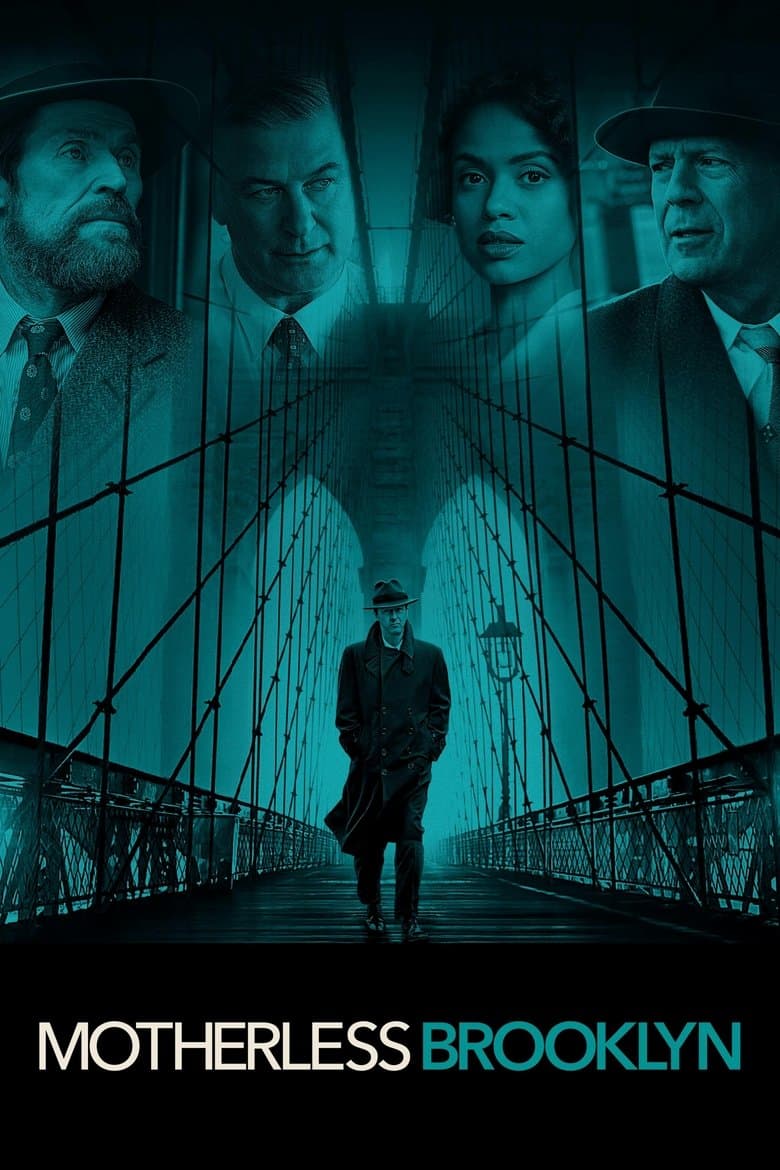
Motherless Brooklyn follows Lionel Essrog, a private detective in 1950s New York. Lionel has Tourette syndrome, a condition that causes sudden movements and words, but his sharp memory helps him work. After his mentor Frank Minna is murdered, Lionel follows clues through Harlem, Brooklyn, jazz clubs, and city offices. He finds a secret plan that connects powerful builders, stolen money, and people being forced from their homes. The film has a dark, slow, old-fashioned detective mood.
The story gives a large role to Laura Rose, a Black Harlem lawyer with a mixed-race family background. She is a skilled ally, a love interest, and a key part of the mystery. The film presents housing clearance as a tool that hurts black communities, and it treats public officials and builders as willing partners in that harm. Laura’s family history ties race directly to the villain’s power and fear. These ideas are important to the plot, but the movie remains mainly a long murder mystery about Lionel’s search for truth and belonging.
Community feedback
Was our 74% Woke rating accurate?
Breakdown
These are the editorial factors and ratings behind our score for Motherless Brooklyn.
Woke representation / casting
Gugu Mbatha-Raw plays Laura Rose, a Black Harlem lawyer with a mixed-race family background. The film makes her a major ally, love interest, and key link to the mystery. The 1950s Harlem setting makes a black woman in this community believable, and the plot explains her mixed-race background. The film created Laura for this adaptation, and interviews framed her as a progressive woman who breaks from the usual 1950s housewife or dangerous love interest.
34%
Woke political dialogue
The public hearing has direct speeches about poor and minority residents, forced moves, and city power. The dialogue says that a neighborhood is not a slum simply because poor people and minorities live there. Moses Randolph answers with praise for a huge clearance plan and a belief that progress excuses the damage. The language fits the 1950s and does not use modern activist slogans.
32%
Identity-driven story themes
The murder case leads Lionel to a plan that buys and destroys poor Black neighborhoods. The film treats the residents' homes and community as something worth defending. Laura's mixed family background becomes a major secret, and Moses's abuse of her mother ties race, gender, and power together. These ideas shape the mystery and ending, even though the film also spends much time on the murder case and Lionel's Tourette syndrome.
58%
Western institutional / cultural critique
The film shows city offices and development companies working together to clear neighborhoods and profit from public money. The story says poor and minority residents are ignored while powerful men decide what counts as progress. Laura and Gabby challenge the officials in public meetings and defend the people being pushed out. Moses also treats his abuse of a black woman as proof that he can do anything, which adds a clear critique of male entitlement to the institutional critique.
55%
Woke character or canon changes
The film keeps Lionel, Frank, the murder, and Lionel's Tourette syndrome from Jonathan Lethem's novel. Norton adds Moses Randolph, Laura Rose, Black neighborhood displacement, and a mixed-race family secret that are not in the book. Those new parts move the story toward racial injustice, housing activism, and abuse of public power. The film adds new people and events instead of changing a known character's identity, but those additions are central to the final story.
51%
Anti-woke backlash and complaints
One Metacritic user called the film political propaganda and objected to its race-focused view of New York. That user also complained that Moses Randolph was shaped to recall Donald Trump. Another Metacritic user said the film rested on a worn-out political agenda, and one Reddit commenter called its view a liberal bias. These were isolated comments, and I found no large campaign calling the film woke or left-wing.
20%
Creator track record context
Edward Norton has the strongest creator signal. His public record includes support for Democratic candidates, environmental work, affordable housing, and comments about racism and inequality. Jonathan Lethem is known for fiction about radical left politics, civil rights, and activism. Other listed producers are mostly neutral, while Gigi Pritzker and Avy Kaufman add some diversity-focused background. This makes the overall context noticeable, but not dominant.
46%
Production
Movie · 2018
Two lifelong friends head up to an isolated Scottish Highlands village for a weekend hunting trip that descends into a never-ending nightmare as they attempt to cover up a…
Movie · 2017
A former rodeo star, now a motel manager, meets a young man who is responsible for the violence that suddenly has seized his small town.
Movie · 2021
A cold and mysterious new security guard for a Los Angeles cash truck company surprises his co-workers when he unleashes precision skills during a heist.

Movie · 2022
After escaping a Michigan prison, a charming career criminal assumes a new identity in Canada and goes on to rob a record 59 banks and jewellery stores while being hunted by a…

Movie · 2016
Irish Commandant Pat Quinlan leads a stand off with troops against French and Belgian Mercenaries in the Congo during the early 1960s.
Movie · 2021
An ambitious carnival man with a talent for manipulating people with a few well-chosen words hooks up with a female psychologist who is even more dangerous than he is.
Movie · 2017
After a botched bank robbery lands his younger brother in prison, Connie Nikas embarks on a twisted odyssey through New York City's underworld to get his brother Nick out of jail.
Movie · 2019
In the wake of his dramatic escape from captivity, Jesse Pinkman must come to terms with his past in order to forge some kind of future.
