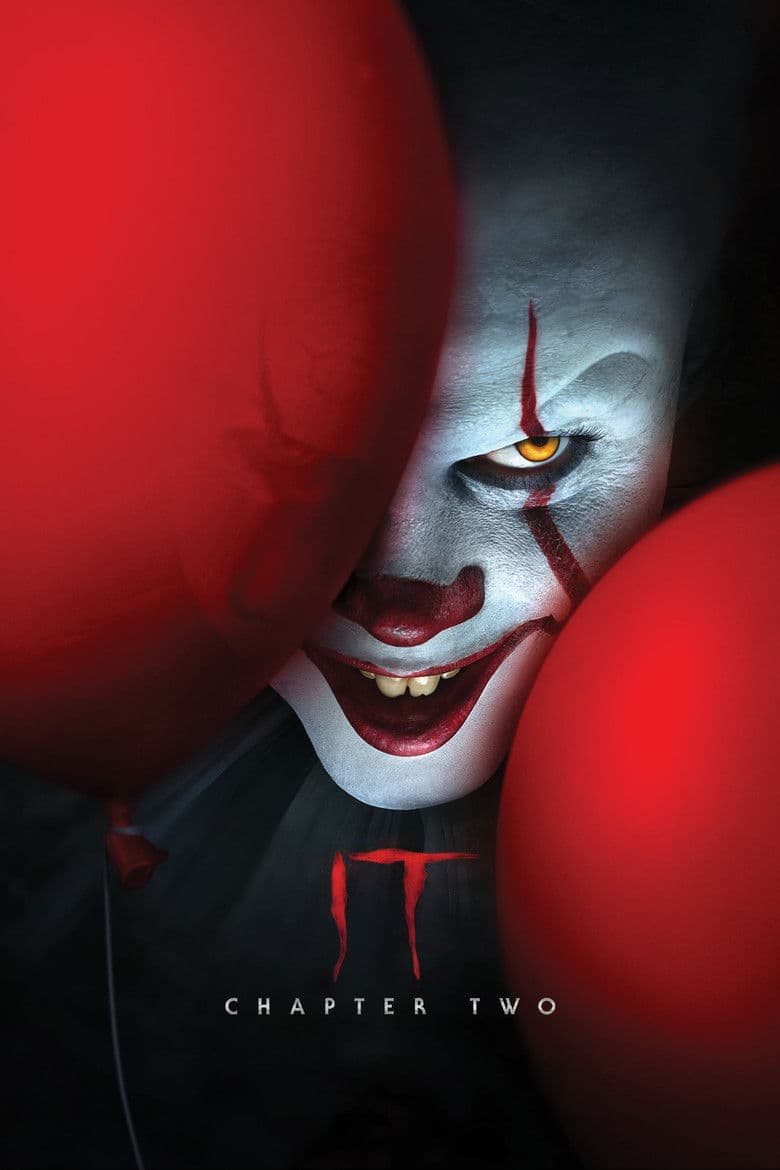
The adult Losers Club is called back to Derry, Maine, twenty-seven years after they first fought the evil clown Pennywise. Mike, the only one who stayed, phones the others when the killings start again. They must face old fears, broken memories, and the monster one last time. The tone is long, scary, and often sad, with big set pieces and heavy talk of friendship and trauma.
The film has clear queer identity material that a normal viewer can see. It opens with a brutal attack on a gay couple, and one man is later killed by Pennywise. Adult Richie’s big secret is that he is gay and has long had feelings for Eddie; Pennywise teases him about outing him, and the story ends with Richie re-carving “R + E” on the kissing bridge as a sign he accepts who he is. Press and the director talked about this as a main emotional thread, not a tiny background detail. The rest of the movie is still a horror story about friendship, guilt, and killing the clown, not a lecture on every modern political cause. Race casting mostly follows the book (Mike is black, as in the novel). Anti-woke backlash stayed limited to fan complaints about the gay subplot rather than a huge public fight.
Community feedback
Was our 62% Woke rating accurate?
Breakdown
These are the editorial factors and ratings behind our score for It Chapter Two.
Woke representation / casting
Not present in this title.
0%
Woke political dialogue
Not present in this title.
0%
Identity-driven story themes
The story opens with a gay hate crime and builds a major arc around Richie hiding that he is gay and loving Eddie. Pennywise uses that secret as a weapon. The ending has Richie accept himself at the kissing bridge. This queer story is easy to see and is treated as a big emotional thread, not a tiny cameo.
72%
Western institutional / cultural critique
Derry is shown as a place where cruelty thrives, including homophobic violence and Beverly’s abusive husband. The film links human hate to the town’s evil, but it does not turn into a long modern lecture on systems like capitalism, whiteness, or the church. The critique is real but secondary to the monster plot.
32%
Woke character or canon changes
The film turns long-running book subtext into a clear queer arc for Richie, with romantic feelings for Eddie made obvious on screen. King did not write Richie as openly gay in the novel, though he later praised the film’s choice. That is a clear identity-focused change to a known character, not just trimming the book.
48%
Anti-woke backlash and complaints
Some fans and online posts said making Richie gay was forced or wrong for the book. That kind of complaint exists, but it did not become a huge national “this movie is woke propaganda” storm. Most public talk was about scares, length, and the queer subplot in mixed terms.
20%
Creator track record context
Key people mostly score low on activist patterns: Muschietti and Dauberman are genre-focused, King is a liberal public figure but not a DEI-first storyteller, and most producers and casting leads are not known for identity campaigns. Dan Lin’s later diversity work raises the team average only a little.
22%
Production
Movie · 2017
In a small town in Maine, seven children known as The Losers Club come face to face with life problems, bullies and a monster that takes the shape of a clown called Pennywise.
Movie · 2025
A couple and their children move into a seemingly normal suburban home. When strange events occur, they begin to believe there is something else in the house with them.
Movie · 2018
A teenager's quest to launch Norwegian Black Metal in Oslo in the 1990s results in a very violent outcome.
Movie · 2020
After a tragic turn of events at the new home he's fixing up, Daniel hears a ghostly plea for help, spurring him to seek out a famous paranormal expert.
Movie · 2018
A disgraced children's puppeteer returns to his childhood home and is forced to confront his wicked stepfather and the secrets that have tortured him his entire life.
Movie · 2024
In 1930s Oklahoma amid the region's horrific dust storms, a woman is convinced that a sinister presence is threatening her family.
Movie · 2020
A couple on a road trip through America encounter a terrifying dark force older than the country itself. An evil that transforms loved ones into someone terrifying, the entity has…
Movie · 2023
On the day of his scheduled execution, a convicted serial killer gets a psychiatric evaluation during which he claims he is a demon, and further claims that before their time is…
