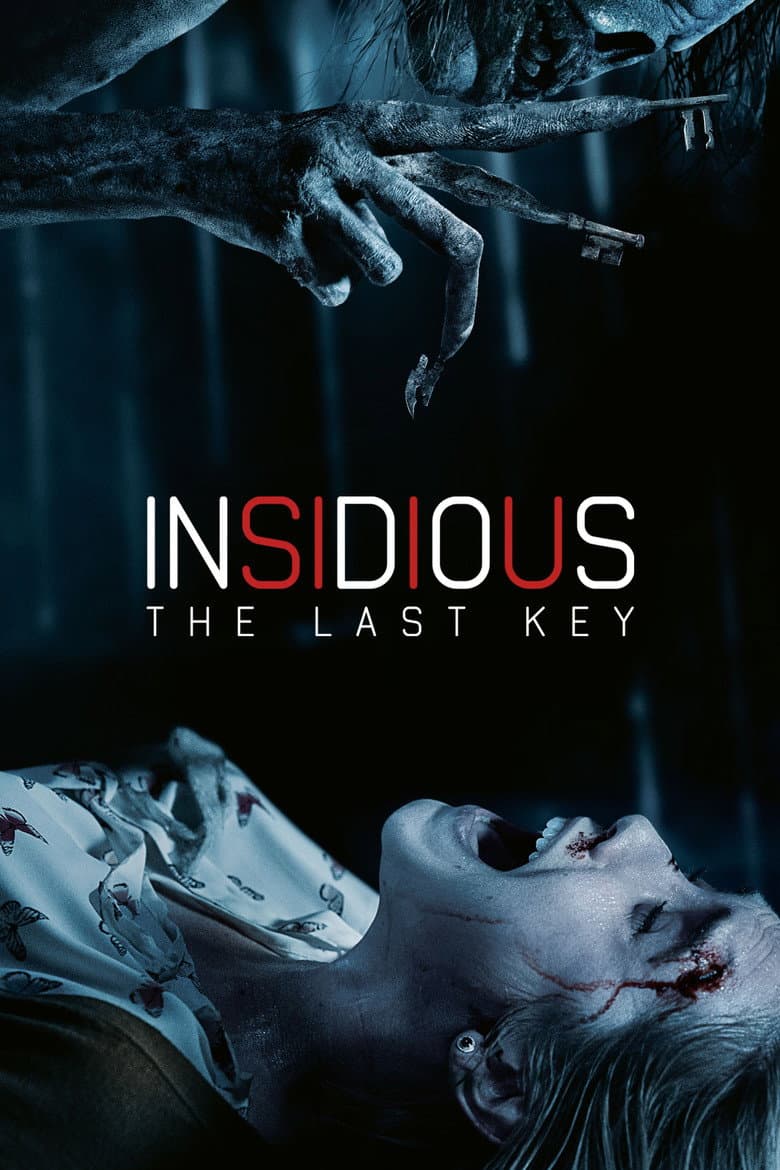
Parapsychologist Elise Rainier returns to her childhood home in Five Keys, New Mexico, after a man reports a haunting there. The case reopens her family trauma from the 1950s, including an abusive father and a mother killed by a demon she accidentally freed. The film mixes ghost hunting set pieces with a personal origin story for the franchise medium. Kidnappings, family reconciliation, and a demon called KeyFace that feeds on fear and hatred drive the plot. The resolution turns on refusing revenge and help from a maternal spirit.
Viewers see an older woman as the franchise hero and women doing much of the emotional and rescue work. Supporting roles include a Latino homeowner antagonist and a black detective with limited screen time. The story focuses on childhood trauma, domestic abuse, and supernatural horror, not modern campaign politics. Some reviewers call the focus on abusive men a feminist angle, but the movie stays in commercial supernatural horror mode. Faith and spirits appear as horror texture only, not as a broad attack on Western institutions.
Community feedback
Was our 21% Woke rating accurate?
Breakdown
These are the editorial factors and ratings behind our score for Insidious: The Last Key.
Woke representation / casting
The cast fits a family story set from the 1950s through modern New Mexico. Elise and her relatives lead the film, and Specs and Tucker return as comic partners. Supporting roles include Latino homeowner Ted Garza and a black detective with limited screen time. The standout choice is an older woman as the franchise hero, earned by prior films. The director frames that choice as empowerment and a rare late career female lead focus.
12%
Woke political dialogue
Not present. Dialogue stays in hauntings, family guilt, abuse memories, and demon hunting. No campaign style or identity politics speech appears.
0%
Identity-driven story themes
The core arc is childhood trauma, an abusive father, and a demon that feeds on fear and hatred. Women including Elise, her nieces, and her mother carry the emotional and rescue work. Reviewers sometimes labeled the focus on male abuse as feminist. The movie tells personal supernatural horror and family reconciliation. It does not present a modern thesis about identity politics or systemic oppression.
22%
Western institutional / cultural critique
Human evil is domestic and criminal, shown through beatings, secret basements, and serial captivity that a demon exploits. The film does not stage a broad attack on Western institutions, capitalism, or Christianity. Faith appears only as horror and supernatural texture through spirits and the Further. That material is not institutional satire.
14%
Woke character or canon changes
Not relevant. The film expands Elise Rainier’s established franchise backstory. It does not race swap or gender swap known figures for identity messaging.
0%
Anti-woke backlash and complaints
Not present. Reception was ordinary mixed franchise criticism about scare quality and sequel fatigue. No sustained anti woke or DEI agenda backlash was found for this title.
0%
Creator track record context
Director Adam Robitel has described himself as a gay filmmaker who values diversity and female led problem solving. On this film he used girl power and empowerment language. Writer Leigh Whannell remains in commercial horror. Producers include James Wan, Jason Blum, and Oren Peli, with casting by Terri Taylor. Overall this is a mild supporting signal, not an activist project.
24%
Production

Movie · 2017
Though Kevin has evidenced 23 personalities to his trusted psychiatrist, Dr. Fletcher, there remains one still submerged who is set to materialize and dominate all the others.
Movie · 2018
A man recently released from a mental institute inherits a mansion after his parents die. After a series of disturbing events, he comes to believe it is haunted.

Movie · 2018
Two sisters are trapped under the fiberglass cover of an Olympic sized public pool and must brave the cold and each other to survive the harrowing night.
Movie · 2023
Recently fired and desperate for work, a troubled young man named Mike agrees to take a position as a night security guard at an abandoned theme restaurant: Freddy Fazbear's…
Movie · 2016
While surfing on a secluded beach, Nancy finds herself in the feeding grounds of a great white shark. Though stranded only 200 yards from shore, survival proves to be the ultimate…
Movie · 2023
Father Gabriele Amorth, Chief Exorcist of the Vatican, investigates a young boy's terrifying possession and ends up uncovering a centuries-old conspiracy the Vatican has…
Movie · 2021
The Blind Man has been hiding out for several years in an isolated cabin and has taken in and raised a young girl orphaned from a devastating house fire.
Movie · 2018
After waking up to find himself all alone in an apartment where a massive party was being held the night before, Sam is immediately forced to face a terrifying reality: the living…
