Movie review
June 15, 2017 · 90 min · PG · Kids · Animation · Comedy · Action · Adventure · Family
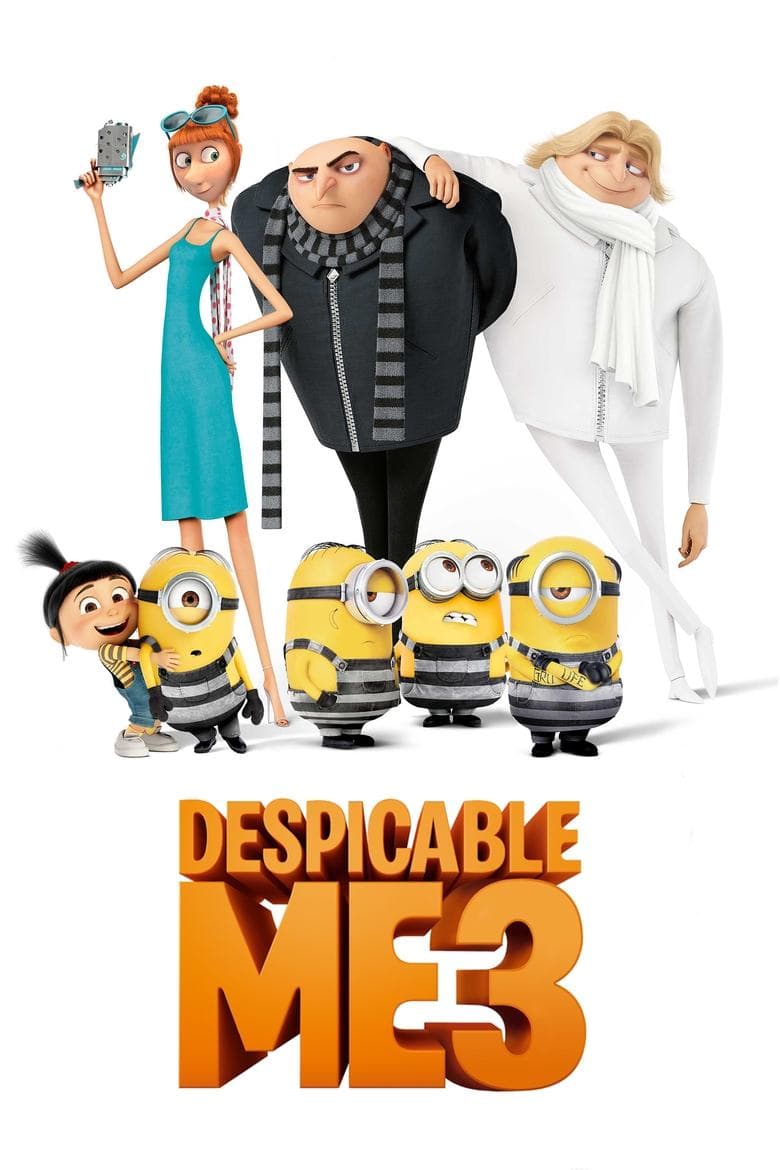
Gru is a former supervillain who now works as an agent with his wife, Lucy. After they fail to catch Balthazar Bratt, the new head of the Anti-Villain League fires them. Gru then meets Dru, the rich twin brother he never knew he had, while Bratt plans to destroy Hollywood with a giant robot and a stolen diamond. The story moves between the agents’ work, Dru’s home in Freedonia, and a bright cartoon version of Hollywood. Its tone is fast, silly, and made for children and families.
Gru and Dru argue over whether Gru should return to crime, but their fight becomes a lesson about brotherly loyalty. Lucy tries to become a good stepmother while still acting as a brave agent, and she helps save the girls during the final attack. The daughters, the Minions, and the brothers all help stop Bratt, so the ending stresses family teamwork and forgiveness. Bratt’s anger comes from losing his old TV show, and the movie treats his attack on Hollywood as a personal joke instead of a serious message about society.
Community feedback
Was our 0% Woke rating accurate?
Breakdown
These are the editorial factors and ratings behind our score for Despicable Me 3.
Woke representation / casting
Not present. The story uses returning characters alongside new male characters Dru and Bratt. The movie does not present their identities as a diversity message. Lucy is a returning agent and wife, while Gru remains the central hero.
0%
Woke political dialogue
Not present. Gru, Lucy, Dru, and Bratt talk about jobs, crime, family, and revenge. The film has no activist speeches or political debate. Its jokes and action do not argue for a modern political cause.
0%
Identity-driven story themes
Not present. Gru’s identity problem is whether to be a hero or a villain after losing his job. Dru wants family approval and Lucy learns how to be a stepmother. These personal struggles do not become race, gender, sexuality, or group-identity politics.
0%
Western institutional / cultural critique
Not present. Bratt attacks Hollywood because his old TV show was canceled and he wants revenge. The film treats this as a silly personal grudge, not as a critique of Western institutions, capitalism, masculinity, or family life. The AVL is a cartoon agency, not a target of modern activist criticism.
0%
Woke character or canon changes
Not relevant. The film adds Dru and Bratt to the existing franchise story. It does not change an established character or real person to make an identity or DEI point.
0%
Anti-woke backlash and complaints
Not present. The supplied X research found no anti-woke posts or named complaints about the film. Reviewed news, audience comments, and reviews focus on humor, story, action, or sequel quality.
0%
Creator track record context
Not present. The supplied creator summaries report no activist or identity-focused pattern among the directors, writers, and producers. Title-related interviews focus on family, sibling love, Lucy becoming a stepmother, and comic performance. No creator statement frames this movie around representation or social-justice messaging.
0%
Production
Movie · 2024
Gru and Lucy and their girls—Margo, Edith and Agnes—welcome a new member to the Gru family, Gru Jr., who is intent on tormenting his dad.
Movie · 2016
The quiet life of a terrier named Max is upended when his owner takes in Duke, a stray whom Max instantly dislikes.
Movie · 2016
While Po and his father are visiting a secret panda village, an evil spirit threatens all of China, forcing Po to form a ragtag army to fight back.
Movie · 2022
After settling in Green Hills, Sonic is eager to prove he has what it takes to be a true hero. His test comes when Dr.
Movie · 2021
Tired of being locked in a reptile house where humans gawk at them like they are monsters, a ragtag group of Australia’s deadliest creatures plot an escape from their zoo to the…
Movie · 2016
An island populated entirely by happy, flightless birds or almost entirely. In this paradise, Red, a bird with a temper problem, speedy Chuck, and the volatile Bomb have always…

Movie · 2024
Garfield, the world-famous, Monday-hating, lasagna-loving indoor cat, is about to have a wild outdoor adventure!
Movie · 2016
When the galaxy comes under the threat of a nefarious space captain, a mechanic and his newfound robot ally join an elite squad of combatants to save the universe.
