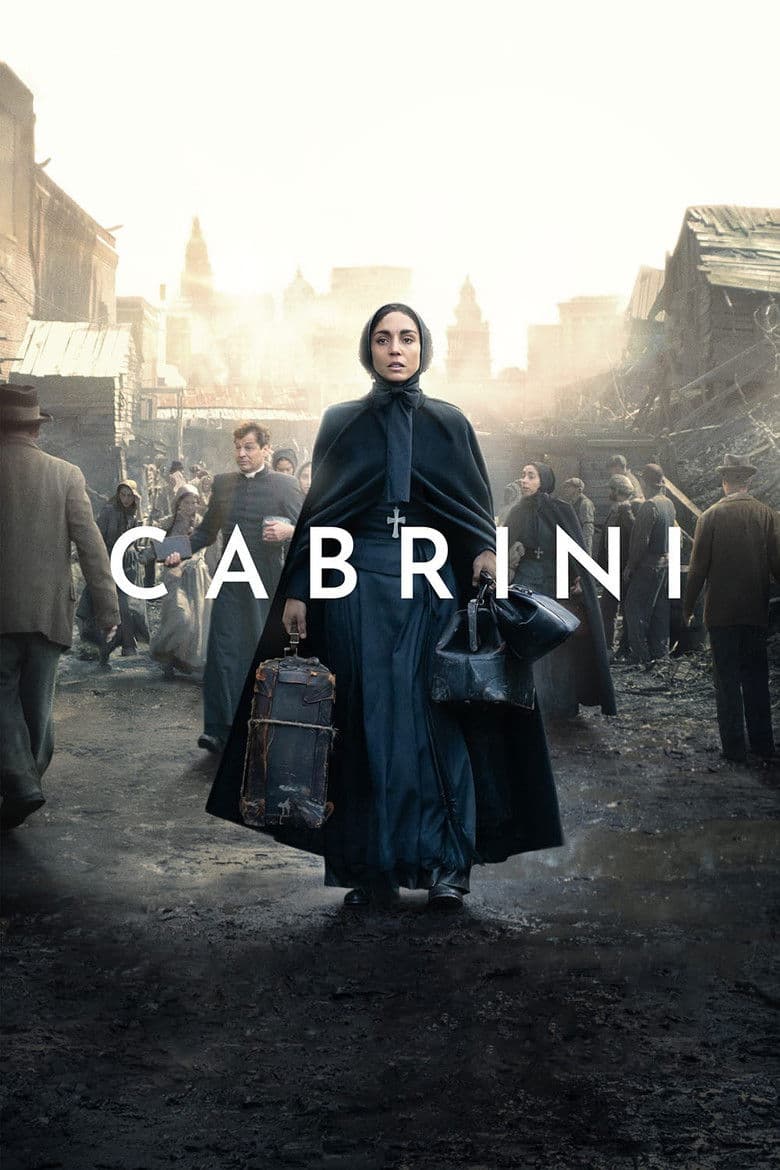
Cabrini follows Francesca Cabrini, a sickly Italian nun who leaves Lombardy for New York in 1889. Pope Leo XIII sends her and her sisters to help poor Italian immigrants after she asks for a mission in China. In the Five Points slum, Cabrini finds abandoned children, disease, crime, and leaders who resist her plans for homes, schools, and a hospital. The story has a serious, inspiring tone and shows her using faith, courage, money skills, and pressure to protect people in need.
The film gives strong attention to a woman leading major work in a world where men control the Church, city government, money, and public speech. Cabrini repeatedly answers sexism, anti-Italian hatred, and poverty with messages about equal human worth, immigrant dignity, and women's ability to lead. The movie presents her as a successful founder whose institutions are run by women, while male officials often look narrow, cruel, or slow to act. These ideas are important throughout the main conflict, but the story still centers on Catholic service, care for children, and personal sacrifice rather than queer or identity-only politics.
Community feedback
Was our 37% Woke rating accurate?
Breakdown
These are the editorial factors and ratings behind our score for Cabrini.
Woke representation / casting
Not present. The lead actor is Italian and matches the real Italian figure. The main cast fits the 1889 setting, with no confirmed diversity-first casting pattern.
0%
Woke political dialogue
The film repeatedly uses speeches about women, immigrants, equal dignity, and what kind of world people should build. Cabrini says women will be expected to fail without men, and she says a loan should be judged the same whether a man or woman owns the building. The lines stay inside the 1889 story, so the movie uses clear social-justice ideas without becoming a present-day political lecture.
28%
Identity-driven story themes
The film makes Cabrini's identity as a woman and Italian immigrant central to her mission. The story repeatedly shows her defeating men who doubt women, helping immigrants treated as less than human, and defending a sex worker from abuse. The ending praises a charitable system run by women and asks what kind of world people want to build. Catholic faith and care for children remain major parts of the message, so identity themes share the story rather than fully control it.
32%
Western institutional / cultural critique
The film presents parts of the Catholic hierarchy, city government, banks, and public life as barriers to Cabrini's work. Male leaders question whether a woman can lead, deny her loans, block donations, and call poor Italians dirty. The story later softens some of these figures, especially the archbishop, and the Pope supports her mission. The critique is tied to 1889 institutions, but its repeated focus on male power and exclusion can sound like modern activist criticism.
32%
Woke character or canon changes
Not relevant. The film tells the story of real Frances Cabrini and uses normal dramatic changes, including a fictional mayor and compressed meetings. No identity-driven change to her character or historical setting is confirmed.
0%
Anti-woke backlash and complaints
Some conservative and Catholic viewers called the movie feminist, girlboss, or social-justice packaging because Cabrini defeats male church and city leaders. Steve Deace said the film gave more weight to social justice than biblical faith, and other traditionalists objected to the weak use of Christ and Mass. Other right-leaning voices defended the film as true faith and real women's empowerment. The backlash was notable but scattered, so it fits a moderate score.
36%
Creator track record context
The director and writers are mainly linked to faith-based and biographical stories. Monteverde's interviews connect the film to immigrant service and describe Cabrini as a powerful woman, while Dell'Anna discusses equality, inclusion, and diversity. Those title-related signals add some context, but the wider team shows no strong pattern of DEI or identity-political work. The overall creator signal stays low.
8%
Production
Movie · 2020
A man refuses all assistance from his daughter as he ages and, as he tries to make sense of his changing circumstances, he begins to doubt his loved ones, his own mind and even…
Movie · 2016
In a desolate war zone where screams of the innocent echo, on the very line between disaster and valor, 7 Maroon Berets will dance with death.
Movie · 2025
A logger leads a life of quiet grace as he experiences love and loss during an era of monumental change in early 20th-century America.
Movie · 2017
Members of the Granite Mountain Hotshots battle deadly wildfires to save an Arizona town.
Movie · 2026
While people across 1990s Iraq struggle to survive the war and food shortages, Saddam Hussein requires each school in the country to prepare a cake to celebrate his birthday.
Movie · 2016
On 15 January 2009, the world witnessed the 'Miracle on the Hudson' when Captain 'Sully' Sullenberger glided his disabled plane onto the Hudson River, saving the lives of all 155…

Movie · 2024
On the brink of the Second World War, a young Norwegian man's drive to resist the Nazis sets a new course for his future – and the future of his country.
Movie · 2023
American ballet dancer Joy Womack is accepted into Moscow's infamously tough Bolshoi Ballet Academy, with the dream of becoming a great ballerina.
