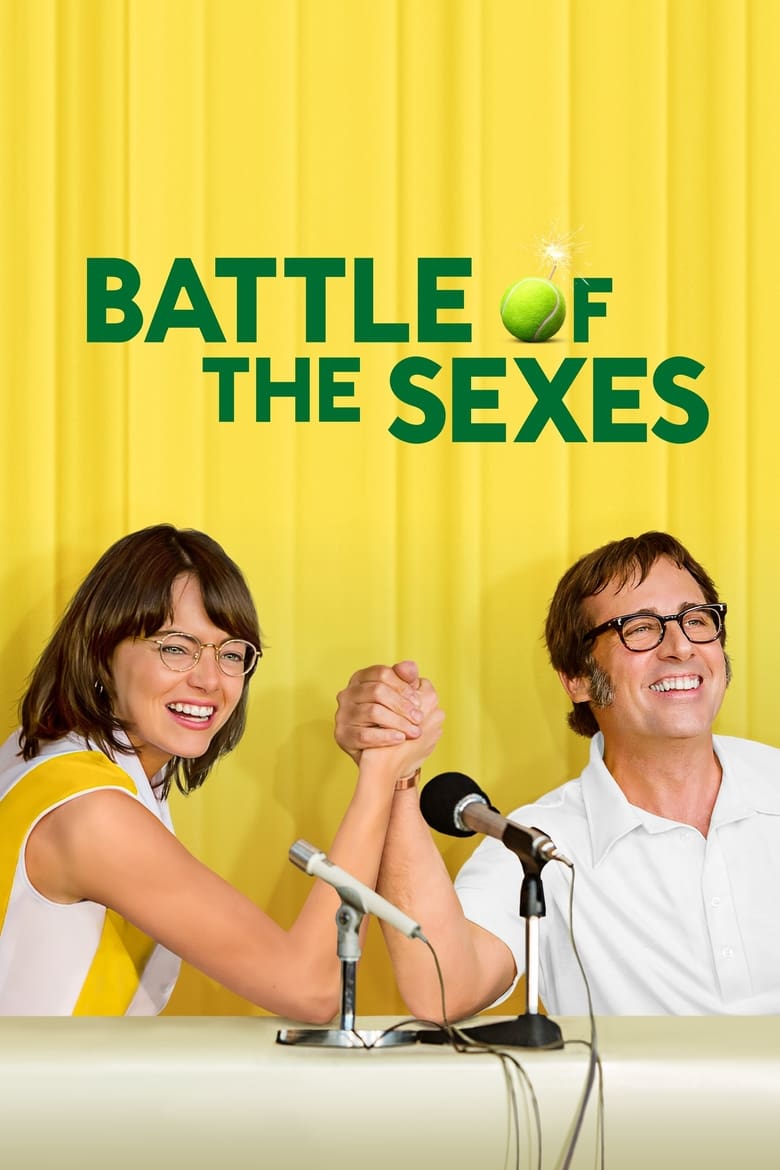
Battle of the Sexes follows Billie Jean King, the top women’s tennis player in 1973. Bobby Riggs, a retired champion and skilled showman, challenges her after he says men are better than women. King is also trying to build a women’s tour because female players receive far less prize money than male players. The story moves through American tennis clubs, small tours, and the packed Houston Astrodome. The movie mixes sports action, comedy, marriage trouble, and a tense public contest.
The film openly supports King’s fight for equal pay and respect. It shows male tennis leaders and commentators treating women as less important, while King and her teammates organize against them. It also shows King’s secret love affair with Marilyn Barnett while King is married, and the story treats their feelings with sympathy. The love story gives the film a clear LGBTQ+ element, but the match and the fight for women’s tennis remain the main focus. The personal story and the public contest are linked because King fears that her private life could hurt the new women’s tour.
Community feedback
Was our 57% Woke rating accurate?
Breakdown
These are the editorial factors and ratings behind our score for Battle of the Sexes.
Woke representation / casting
Not present in this title.
0%
Woke political dialogue
King and the women players argue that women deserve equal pay and respect. Kramer tells King that sports and business are a man’s world. Riggs repeats that women are inferior and belong in the kitchen. These lines appear throughout the 1970s story, but they describe the period conflict instead of using modern activist slogans.
34%
Identity-driven story themes
King begins a same-sex relationship with Marilyn Barnett while she is married to Larry. The film shows her attraction, secrecy, fear of losing sponsors, and conflict about her public image. The filmmakers link her private identity struggle to her public fight for equal pay and respect. The relationship is a sympathetic and visible subplot with intimate scenes. The tennis match remains the main event, so this theme is important but not the whole movie.
62%
Western institutional / cultural critique
King repeatedly faces a male-led tennis system that pays women far less and treats their work as less valuable. Kramer and other men defend old gender roles, while King challenges their control of the sport. The film also mocks Riggs’s public sexism and the men who cheer him on. The criticism stays tied to the 1970s tennis world and does not become a broad attack on Western society or capitalism.
27%
Woke character or canon changes
Not relevant. The film is loosely based on real 1973 events and people. Main facts (the match, equal-pay fight, outcome, and King's personal circumstances) track historical record, with standard dramatization and compression for storytelling. No clear identity-driven or DEI-style alterations to historical figures or events.
0%
Anti-woke backlash and complaints
A conservative review called the movie “woke cinema” and said it preached women’s equality and gay rights. Another right-leaning review said some conservatives found it too woke, even though its writer enjoyed the history. Some audience reviews also objected to making King’s sexuality a major subplot. The complaints were limited to scattered reviews and online comments, with no large boycott or organized campaign.
33%
Creator track record context
Dayton and Faris mostly make character-focused stories about personal relationships. Beaufoy often writes about class hardship and people who overcome difficult odds. Boyle adds a mild left-leaning signal and has spoken about cultural care in creative work. The supplied creator context does not show a strong repeated pattern of DEI, identity, or queer activism.
31%
Production
Movie · 2018
Tony Lip, a bouncer in 1962, is hired to drive pianist Don Shirley on a tour through the Deep South in the days when African Americans, forced to find alternate accommodations and…

Movie · 2016
Mia, an aspiring actress, serves lattes to movie stars in between auditions and Sebastian, a jazz musician, scrapes by playing cocktail party gigs in dingy bars, but as success…

Movie · 2022
The remarkable true story of how retiree Jerry Selbee discovers a mathematical loophole in the Massachusetts lottery and, with the help of his wife, Marge, wins $27 million…

Movie · 2016
Two high school girls are best friends until one dates the other's older brother, who is totally his sister's nemesis.

Movie · 2024
Mismatched cousins David and Benji reunite for a tour through Poland to honor their beloved grandmother. The adventure takes a turn when the pair's old tensions resurface against…
Movie · 2022
Maurice Flitcroft, a dreamer and unrelenting optimist, managed to gain entry to The British Open Golf Championship qualifying in 1976 and subsequently shot the worst round in Open…
Movie · 2018
A police officer faces a personal meltdown following a divorce and the death of his mother.
Movie · 2020
Scott has been a case of arrested development ever since his firefighter father died when he was seven. He's now reached his mid-20s having achieved little, chasing a dream of…
