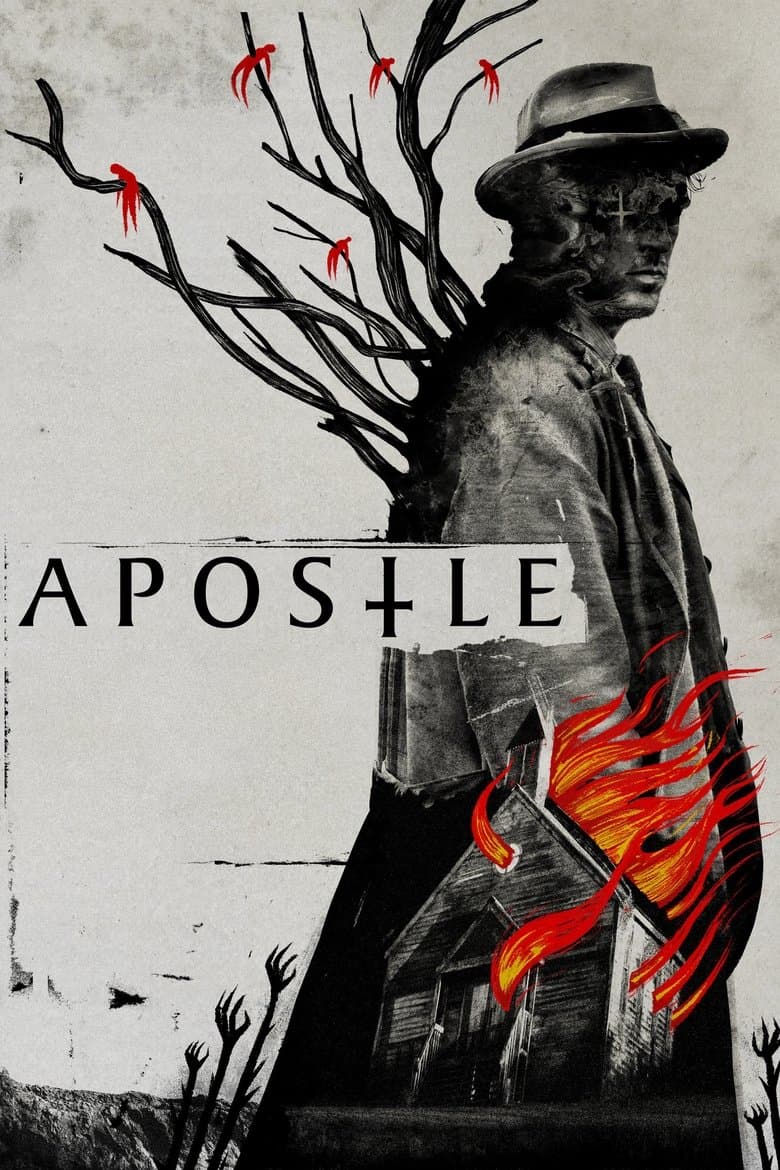
In 1905, Thomas Richardson travels to a remote Welsh island after a cult kidnaps his sister, Jennifer. Thomas is a former missionary who has lost his faith after suffering during a violent uprising in China, and he hides his past while entering the group. Malcolm claims that his community offers freedom, equal treatment, and food for all, but he rules through fear, guards, punishments, and blood sacrifice. The film starts as a tense rescue mystery and grows into slow, brutal folk horror with torture, murder, sexual threat, and a living goddess tied to the island.
The clearest modern social theme is the film's attack on men who use religion, sex, and power to control other people. The story shows women being treated as property, while the female spirit that gives the island life is chained and forced to serve the group. Malcolm's promise of an equal society also carries a mild communist idea, but the film shows that promise turning into a harsh class system. These themes are part of the horror, yet the movie remains focused on a corrupt cult and supernatural violence rather than current identity politics.
Community feedback
Was our 35% Woke rating accurate?
Breakdown
These are the editorial factors and ratings behind our score for Apostle.
Woke representation / casting
Not present in this title.
0%
Woke political dialogue
Malcolm's speeches promise equality, freedom, no taxes, and shared food. The film shows these ideas as the public face of an early communist-style project. The leaders then keep a hierarchy, a curfew, and a police state behind those promises. The story uses this political talk to explain the cult's rise and failure, but it does not use modern identity or activist language.
15%
Identity-driven story themes
Male leaders make control of women a clear part of the horror. Quinn kills his pregnant daughter Ffion during a forced abortion and later plans to use Jennifer and Andrea for repeated pregnancies and child sacrifice. The men also chain the female spirit that keeps the island alive and force her to serve them. These scenes support a theme about patriarchy and toxic masculinity, but the film presents it through a period cult story rather than a current identity campaign.
42%
Western institutional / cultural critique
The film links religious control with political control. The cult promises freedom but keeps a hierarchy, a curfew, punishment, and forced sacrifice. The male leaders also use the island's faith to control women and the land. The story attacks corrupt power in a made-up cult, but it does not become a broad attack on modern Western society, capitalism, or Christianity itself.
28%
Woke character or canon changes
Not relevant. Original story with no established characters, canon, or historical figures altered through identity or DEI lenses.
0%
Anti-woke backlash and complaints
Not present. No documented anti-woke or right-leaning complaints treating the film as pushing woke, DEI, or identity politics messaging. Public discussion stayed within artistic and horror genre terms.
0%
Creator track record context
Gareth Evans has a cached 23/100 score. His main work is action and horror, with no repeated focus on race, gender, or queer politics. His Apostle interviews connect the film to toxic masculinity and to people using faith for political gain. The other cached creators have low scores and no strong identity-driven work tied to this film.
23%
Production
Movie · 2017
Law enforcement finds itself chasing the ghost of a man dead for over a decade, embroiled in a diabolical new game that's only just begun.
Movie · 2017
Two young women at a prestigious prep school are assailed by an evil, invisible power when they're stranded over winter break.
Movie · 2016
A young nurse takes care of an elderly author who lives in a haunted house.
Movie · 2023
After a Black Friday riot ends in tragedy, a mysterious Thanksgiving-inspired killer terrorizes Plymouth, Massachusetts - the birthplace of the holiday.
Movie · 2025
Plagued by a violent recurring nightmare, college student Stefanie heads home to track down the one person who might be able to break the cycle and save her family from the grisly…
Movie · 2024
After the brutal murder of her twin sister, Darcy goes after those responsible by using haunted items as her tools for revenge.
Movie · 2021
Madison is paralyzed by shocking visions of grisly murders, and her torment worsens as she discovers that these waking dreams are in fact terrifying realities with a mysterious…

Movie · 2024
After reluctantly moving to the German Alps with her father and his new family, Gretchen discovers that their new town hides sinister secrets, as she's plagued by strange noises…
