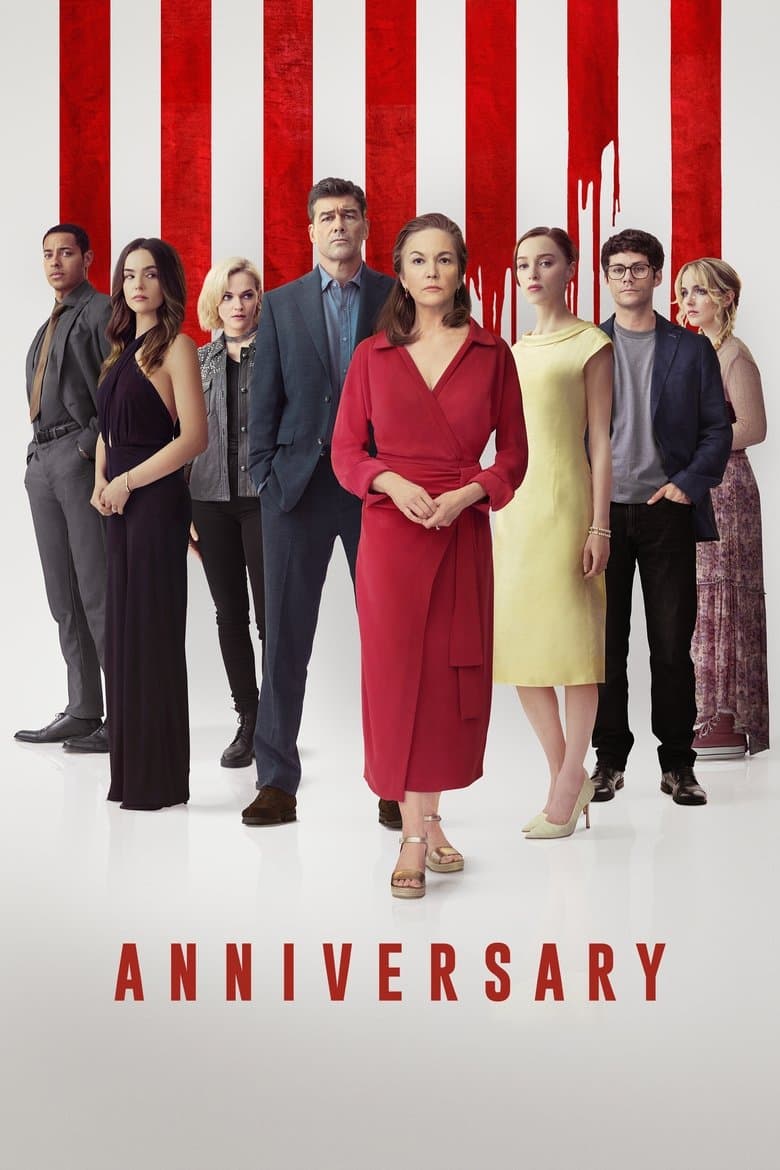
Anniversary follows Ellen Taylor, a Georgetown professor, and Paul, a Washington, D.C. restaurant owner, as their family gathers for their 25th wedding anniversary. Their son Josh brings Liz, a former student of Ellen who once argued for a one-party state. Liz's book, The Change, grows from a strange idea into a national movement that takes control of public life and turns the family against itself. The film has a cold, tense tone and jumps through five years of dinners, holidays, and family parties.
The film presents Anna, a lesbian daughter who works as a comedian, and Cynthia, a daughter who works as an environmental lawyer. It also places women in major roles as a professor, a young scientist, and the writer who starts the political movement. These choices create visible representation, but sexuality and gender do not control the main story. The strongest woke material comes from repeated attacks on liberal academia, free speech, and democratic institutions, while the Change movement is shown as a right-wing-coded road to control, violence, and prison. The film treats resistance to that movement as justified, although it says little about the movement's exact beliefs.
Community feedback
Was our 50% Woke rating accurate?
Breakdown
These are the editorial factors and ratings behind our score for Anniversary.
Woke representation / casting
The core family includes a lesbian daughter and an interracial couple. The main women include a professor, an environmental lawyer, a young scientist, a comedian, and a political writer. The modern Washington setting makes these choices believable, and the film does not present them as a diversity campaign. The visible identity pattern is present but not heavy.
15%
Woke political dialogue
Ellen debates claims that universities promote radical liberalism and defends open debate. The family argues about feminism, abortion, environmental politics, free speech, and political loyalty. Liz's book promises to end left and right parties, but it produces a single-party state that suppresses dissent. The movement's exact policies stay vague, even though political conflict drives the film.
50%
Identity-driven story themes
Anna is a lesbian comic with a female partner, and her jokes about The Change lead to attacks and hiding. Her stage material includes feminism and a woman's right to choose. Cynthia's abortion adds another visible gender and family-choice issue. The main story remains about political control, family revenge, and the loss of democracy.
20%
Western institutional / cultural critique
The film turns a modern Washington, D.C. family into a picture of national collapse. The Change is backed by a corporation and uses flags, surveillance, census checks, threats, and police violence against professors, comedians, students, and journalists. The movement is coded as right-wing populist, while liberal academia and free speech are treated as values worth defending. The film also blames the family's smugness and failure to listen, so its critique targets authoritarian power more than every conservative belief.
51%
Woke character or canon changes
Not relevant. The film is an original story with no established characters, source canon, or real historical figures being changed.
0%
Anti-woke backlash and complaints
A handful of small X accounts called the film Democrat propaganda, political slop, and predictive programming. Some small online viewers also called it left-wing propaganda because the movement resembles a right-wing threat. The reaction had very low reach and no major boycott, review-bombing campaign, or organized backlash.
16%
Creator track record context
Jan Komasa's stored record includes repeated stories about social pressure, faith, and authoritarian rule. Lori Rosene-Gambino has a record of social and political storytelling but no clear identity-activist pattern. Diane Lane has supported women's causes and climate protests, while Paula Mae and Steve Schwartz backed an ASL-inclusive stage production. The wider creator group shows little public activist or DEI focus.
20%
Production
Movie · 2021
A head chef balances multiple personal and professional crises at a popular restaurant in London.

Movie · 2025
A broker of lucrative payoffs between corrupt corporations and the individuals who threaten them breaks his own rules when a new client seeks his protection to stay alive.
Movie · 2017
A former rodeo star, now a motel manager, meets a young man who is responsible for the violence that suddenly has seized his small town.

Movie · 2016
Irish Commandant Pat Quinlan leads a stand off with troops against French and Belgian Mercenaries in the Congo during the early 1960s.
Movie · 2024
While awaiting the next fuel truck at a middle-of-nowhere Arizona rest stop, a traveling young knife salesman is thrust into a high-stakes hostage situation by the arrival of two…

Movie · 2016
When Iraq invades Kuwait in August, 1990, a callous Indian businessman becomes the spokesperson for more than 170,000 stranded countrymen.
Movie · 2024
During the 1972 Munich Olympics, an American sports broadcasting crew finds itself thrust into covering the hostage crisis involving Israeli athletes.

Movie · 2024
A ride-share turns into a high-stakes game of cat and mouse after it follows a car fitting the description of an AMBER Alert.
