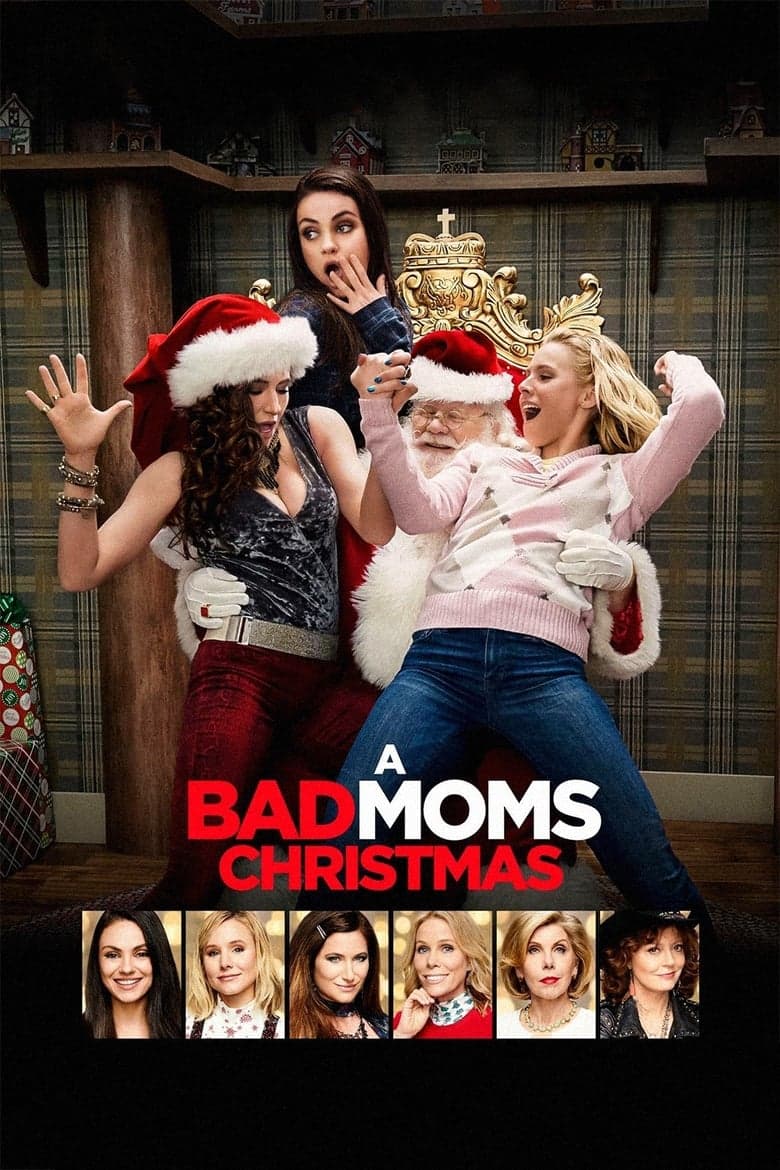
Amy, Kiki, and Carla are three suburban mothers who feel crushed by the work of Christmas. Amy wants a quiet holiday with her children, but her strict mother Ruth arrives and takes over the house. Kiki deals with a mother who will not give her space, while Carla faces her unreliable mother, Isis. The women drink, steal a tree, fight with their families, and try to repair their mother-daughter bonds in a loud R-rated comedy.
The film treats motherhood as work that women are expected to do perfectly, especially during the holidays. The friends complain that women must buy gifts for everyone and ask why their husbands cannot do the same. The story supports setting limits, lowering expectations, and accepting imperfect family life, but it does not build a larger political case. A brief comic same-sex kiss involving Carla is the clearest LGBTQ element, while the main story stays focused on female friendship, family stress, sex jokes, drinking, and forgiveness.
Community feedback
Was our 29% Woke rating accurate?
Breakdown
These are the editorial factors and ratings behind our score for A Bad Moms Christmas.
Woke representation / casting
Not present in this title.
0%
Woke political dialogue
The friends complain that women are expected to buy gifts for the whole family. Amy asks why her husband cannot buy presents for his own mother. The exchange links that burden to being a girl and to the year 2017. The film keeps this point inside one short joke scene and does not turn it into a longer political speech.
18%
Identity-driven story themes
The story repeatedly shows mothers pushing back against the idea that they must make a perfect holiday. Amy, Kiki, and Carla seek more freedom, space, and respect while they handle family duties. The film also shows a brief comic same-sex kiss involving Carla, which adds a small queer identity element. The main message stays about personal stress, friendship, forgiveness, and family instead of a large identity-political program.
30%
Western institutional / cultural critique
The film mocks the idea that mothers should do all the holiday work and hide their stress. Amy questions why her husband cannot buy gifts for his own mother. The women reject costly decorations, forced parties, and perfect family images. The movie treats these problems as personal pressure and consumer excess, not as a broad attack on capitalism, Christianity, or Western institutions.
28%
Woke character or canon changes
Not relevant. This is an original story and set of characters with no source material, historical figures, or established canon being reinterpreted through identity or DEI lenses.
0%
Anti-woke backlash and complaints
Not present. There are no notable anti-woke or right-leaning complaints in reviews, news, or social media that accuse the film of advancing woke, DEI, representation-first, or left-wing political content. Public discussion stayed on humor, raunch, and entertainment value.
0%
Creator track record context
Jon Lucas and Scott Moore have a commercial comedy record with no documented activist pattern. Suzanne Todd has supported stories about women’s lives and challenges and has described herself as an activist. Her wider work includes projects about reproductive rights and lesbian experiences, but that pattern is not the main subject of this film. The creative background adds a mild signal without showing a strong title-specific agenda.
18%
Production
Movie · 2016
A comedy that follows a group of friends as they navigate their way through the freedoms and responsibilities of unsupervised adulthood.
Movie · 2023
A chaotic intervention. An action-packed stay in rehab. After a weird couple of years, John Mulaney comes out swinging in his return to the stage.
Movie · 2024
Inseparable best friends AJ and Moose decide to run the local pool's snack shack after their plan to sell home-brewed beer goes down the drain.
Movie · 2023
Leo and Angela Russo live a simple life in Queens, surrounded by their overbearing Italian-American family. When their son finds success on his high school basketball team, Leo…
Movie · 2018
Adam Sandler takes his comical musical musings back out on the road, from comedy clubs to concert halls to one very unsuspecting subway station.
Movie · 2016
Two teenage boys from inner-city Cork steal bicycles and ride off on a 160km quest to find an unrecovered bale of cocaine worth 7,000,000 euros.

Movie · 2022
Two lifelong friends find themselves at an impasse when one abruptly ends their relationship, with alarming consequences for both of them.
Movie · 2022
Exploring every facet of ‘Weird Al’ Yankovic’s life, from his meteoric rise to fame with early hits like ‘Eat It’ and ‘Like a Surgeon’ to his torrid celebrity love affairs and…
